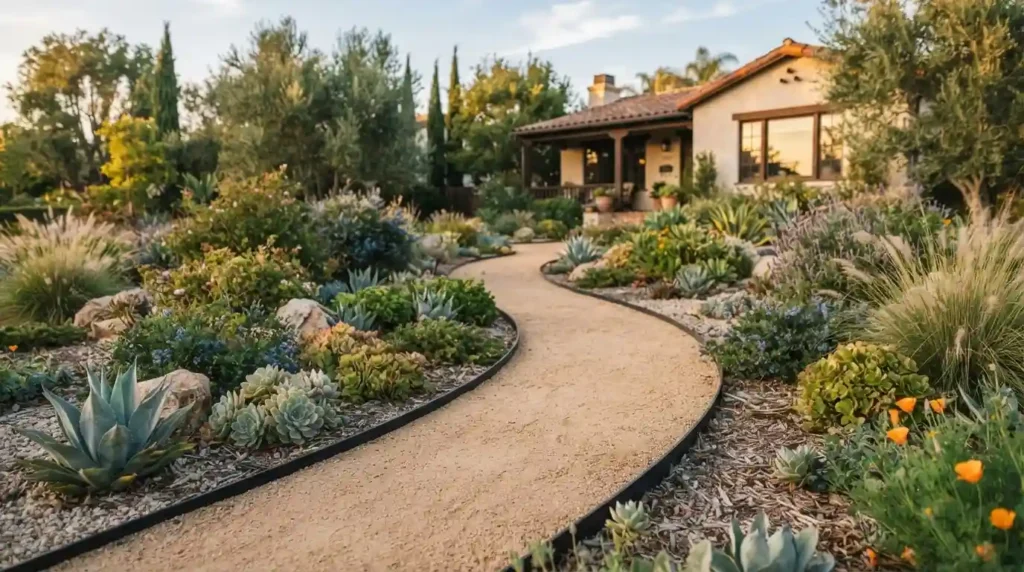
DG in landscaping stands for decomposed granite. It is a mix of small granite pieces and fine granite dust, usually 3/8 inch or smaller. When compacted, it forms a firm, water-permeable surface. Homeowners use it for paths, patios, driveways, and open ground cover.
This guide explains what DG is, how it works, and where it fits in San Diego County yards. It also shows where DG fails, so you can decide before you spend any money.
Key Takeaways
- DG means decomposed granite, a mix of small granite pieces and fine dust.
- The fines pack tight when damp and compacted, so DG forms a firm surface that still drains.
- Natural DG suits light use. Stabilized or resin-coated DG suits steady traffic, slopes, and driveways.
- DG needs a compacted base and edging. Skipping either one shortens its life.
- In San Diego, DG fits water-wise and fire-smart yards. Loose DG still tracks indoors and washes out on slopes.
What Does DG Stand For in Landscaping?
DG stands for decomposed granite. Granite is a hard igneous rock. Weather and erosion slowly break it into small gravel and fine dust, according to Gardenista.
Landscaping DG goes by many names. Suppliers sell it as crusher fines, granite fines, screenings, stone dust, and rock fines, as Aggregate Markets explains.
Here is a detail most guides skip. Some DG weathers in nature. Some are crushed and screened at a quarry. Both are sold as DG, and the color and fines level change by quarry.
Ask your supplier for the product name and the gradation, such as “3/8 inch minus.” That label tells you more than the letters DG do.
What Is DG in Landscaping, and How Does It Work?
DG in landscaping is a compactable granite surface material. The small stones give it structure. The fine dust locks them together when the material is damp and packed down.
Suppliers grade DG by its largest particle. A 3/8 inch minus product holds pieces from 3/8 inch down to fine dust. A 1/4 inch minus product has more fines and a smoother surface, according to Hello Gravel.
Why do the fines matter?
The fines act as the glue in loose DG. When rain washes them out, the coarser stones loosen and the surface turns uneven, as Select Surfaces Group describes.
That is why base prep and edging matter so much. They keep the fines in place.
Why does DG drain water?
DG is permeable, so rain soaks through instead of running off. Lowe’s lists drainage as a core feature.
This matters in San Diego. The County states that runoff in San Diego is not treated before it enters local waterways. A surface that absorbs rain sends less of it down the storm drain.
What Is Decomposed Granite Used For?
Decomposed granite is used for paths, patios, driveways, ground cover, and base layers. About Mechanics also notes its use on trails and parking areas.
- Paths. Many suppliers call DG the most popular pathway material because it compacts into a firm, natural surface.
- Patios and seating areas. DG patios drain on their own and work around fire pits, per Earth Stone Rock.
- Driveways. Use stabilized or resin-coated DG over a compacted base. Plain DG ruts under tires.
- Open ground cover. DG replaces turf or mulch in areas with no plants.
- Fire breaks. UC Cooperative Extension notes that DG, gravel, cement, and asphalt paths make effective firebreaks.
- Base layers. Some suppliers sell it as a compactable base, such as Soil Direct.
Sources disagree on one point. Angi says natural DG is not ideal for driveways, paths, or patios, and recommends stabilized DG. Some suppliers say plain DG works for light garden paths. Both can be true. It depends on traffic and slope.
What Are the Types of Decomposed Granite?
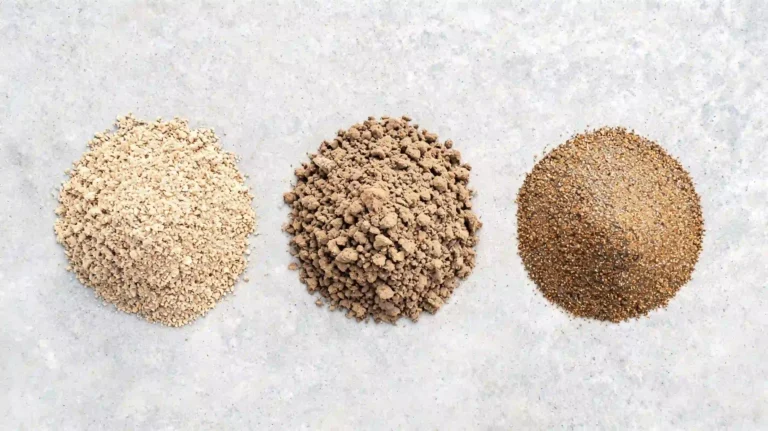
There are three main types: natural (loose), stabilized, and resin-coated. Hunker and Angi both list these three.
Type | What it is | Feel and hold | Best use | Relative cost |
Natural (loose) | Granite and fines with no binder | Softer. Can rut and track | Garden beds, light paths, open ground cover | $ |
Stabilized | DG blended with a binder that locks the fines together | Firm. Resists erosion and tracking | Paths, patios, slopes, steady foot traffic | $$ |
Resin-coated | DG with a resin coating. Looks natural, acts like asphalt, still permeable | Firmest and most stable | Driveways and heavy use | $$$ |
Angi puts stabilized DG above natural DG in price, and resin-coated above both. Earth Stone Rock describes stabilized DG as firm and shape-holding, where loose DG can rut.
Binders vary by product. One common type is a water-activated, psyllium-based binder. Read the product sheet before you buy.
How Is a DG Surface Built?
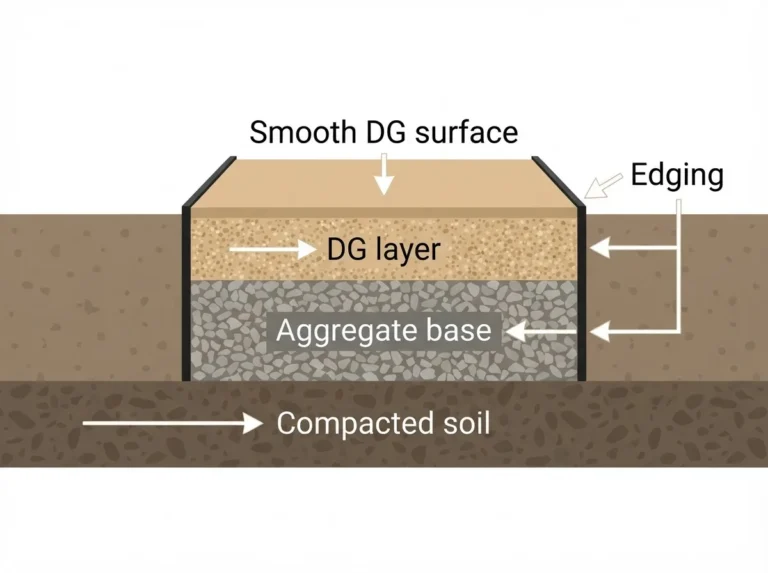
A good DG surface has four parts: a compacted base, edging, the DG layer, and compaction. This overview helps you judge a quote. It is not a do-it-yourself manual.
- Mark the area and dig out the soil. The depth equals the base layer plus the DG layer.
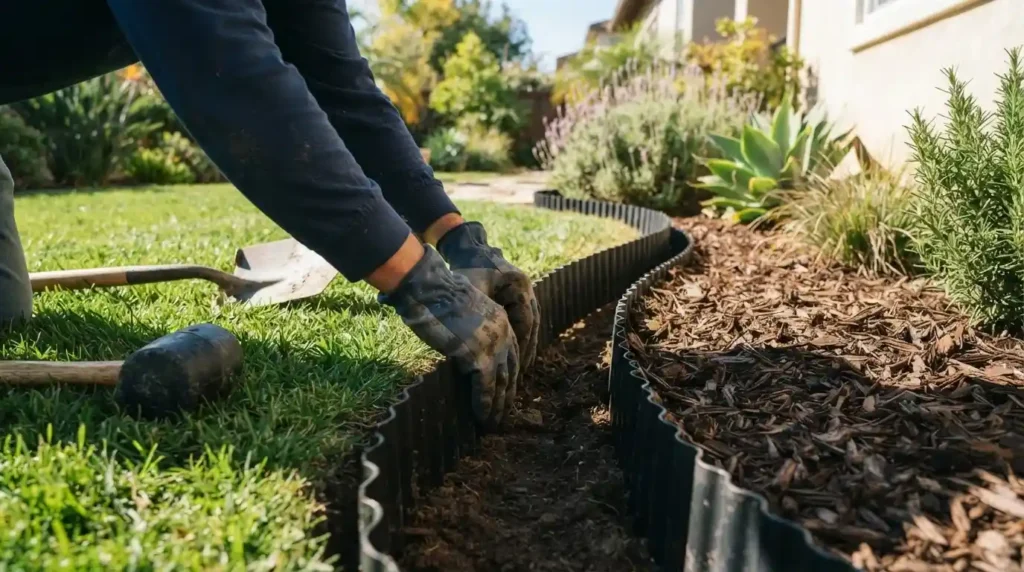
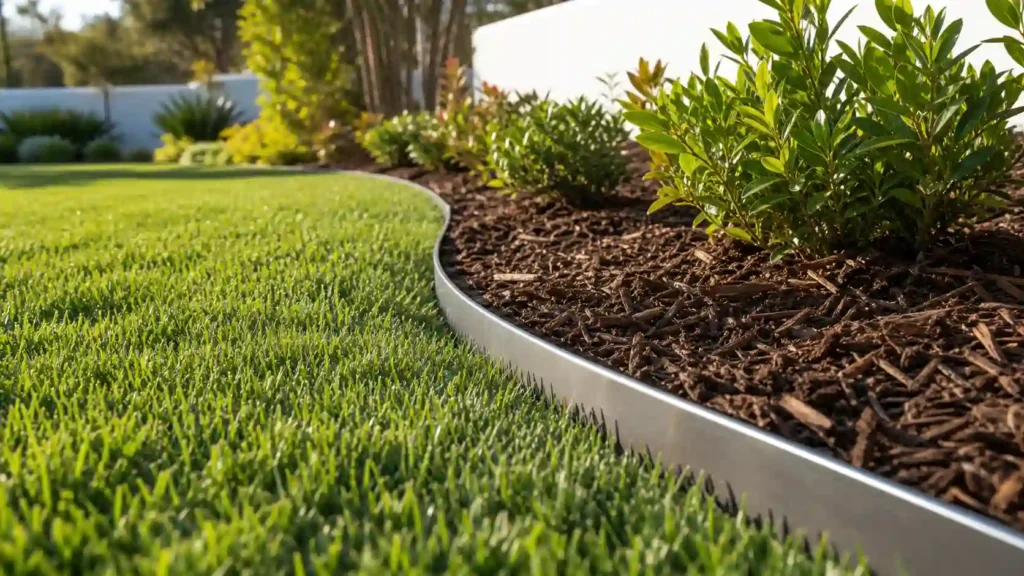
- Set the edging. Water-wise garden guidance says DG paths and patios need edging in metal, plastic, or rock. It holds the edge and allows compaction.
- Compact the soil and add an aggregate base. One supplier spec sheet calls for a 4 to 6 inch compacted base. That is about 4 inches for paths and 6 for driveways.
- Add the DG in layers. The same sheet lists 3 to 4 inches for walkways and 5 to 6 for driveways. It uses 2 inch lifts when the total tops 3 inches.
- Dampen and compact each layer. The sheet calls for compaction of at least 92 to 95 percent, depending on use.
- Let stabilized DG set. Landscape Architect Magazine says stabilized DG should rest six to 48 hours before compacting. It also says it cannot go in during rain.
Depth advice varies by supplier. Another supplier lists 2 to 3 inches for paths and patios. Follow the product sheet for the material you buy.
Weed fabric is optional. It slows weeds, but no fabric is fully weedproof, and clogged fabric can slow drainage.
What Are the Benefits of Decomposed Granite?
DG gives a natural look, drains well, and costs less than most paving. It also fits water-saving yard plans.
- Natural look. Tan and gold tones blend with San Diego yards, according to a local contractor guide.
- Lower material cost. HomeAdvisor calls DG a cost-effective surface compared with stone pavers or concrete.
- Permeable surface. Rain soaks in rather than pooling or running off.
- Water-saving option. San Diego water guidance suggests permeable hardscape like gravel or decomposed granite paving in place of traditional turf grass.
- Reasonable lifespan. Angi says DG can last up to 10 years when installed well.
- Fire-resistant surface. DG does not burn, which helps near structures.
Where Does DG Fit in San Diego County?
A decomposed granite landscape fits San Diego well for water-wise and fire-smart design. It needs care on slopes and near doors.
Water-wise yards and turf replacement
The County’s turf replacement option lists decomposed granite pathways as an eligible non-irrigated, erosion-resistant surface. It applies to unincorporated San Diego County properties not served by certain water agencies.
The County’s Waterscape rebate page requires that hardscape in the project area be permeable. Rules and eligibility change. Confirm yours before you start work.
San Diego water guidance also says to use DG only in areas without plants. The Water Authority’s mulch advice lists decomposed granite as a mulch for areas without plants. Plant beds need organic mulch instead.
Fire-smart design
Cal OES states that Zones 1 and 2 make up the 100 feet of defensible space required by law. A third zone was added by AB 3074.
UC Master Gardeners list decomposed granite among the non-combustible materials for the area next to the house. They also advise no plants within 5 feet. Check with your local fire agency for the rules that apply to your lot.
Rain and slopes
San Diego is dry most of the year, but storms arrive hard. One January storm averaged about 2.9 inches of rain across the county in a single day.
Loose DG can turn muddy and wash away in rain, as Angi warns. Water-wise garden guidance adds that DG is prone to erosion on steep slopes. Stabilize it or pick another material on slopes.
Next to artificial turf
Fines travel on shoes and dog paws. A loose DG path beside artificial turf will drop fines onto the turf. Our recommendation is a stabilized mix and a firm edge between the two surfaces.
What Are the Downsides and Common Mistakes With DG?
DG fails when the base, edging, or type is wrong. These are the most common errors.
- Skipping the base. Rock spread on soft soil sinks and mixes with dirt.
- Skipping the edging. Without it, DG spreads into beds and lawns. Sunset notes DG needs something to hold it in place.
- Using loose DG at the door. Grit gets tracked inside and can scratch hardwood floors. Water-wise guidance suggests keeping DG away from the area right next to the house.
- Using it on a steep slope. Angi says a slight slope is fine, but a steep one is not advised.
- Using it as mulch around plants. San Diego guidance says inorganic mulches do not feed soil life and suit pathways. DG is not a soil builder.
- Trusting fabric to stop weeds. Angi states that no ground cover is completely weed-proof. Sunset adds that moss and weeds still grow in shaded, moist DG.
- Expecting zero upkeep. A Gardenista designer says DG needs more maintenance than you might expect. Plan to rake it and top it up.
How Do You Know If DG Is Right? The DG Fit Test
Answer three questions. Who walks here? How steep and wet is the spot? How close is it to the door? The table turns your answers into a material choice.
Your answers | Best choice |
Light foot traffic, flat ground, away from the door | Natural DG with edging |
Daily traffic, a slight slope, or a patio | Stabilized DG |
Wheeled traffic, vehicles, or a route that must be firm and stable | Stabilized or resin-coated DG over a compacted base, or pavers |
Steep slope, or a spot right at an entry | Pavers, concrete, or flagstone |
This is a rule of thumb built from the sources above, not a code standard. Stabilized DG can meet accessibility needs when installed correctly. The California Building Code says binders can help provide a firm, stable, slip-resistant surface. It adds that such surfaces should be edged. For required accessible routes, check with your building department.
Your DG checklist before you buy or hire
- Ask the supplier for the product name and gradation, such as 3/8 inch minus.
- Choose natural, stabilized, or resin-coated based on traffic and slope.
- Confirm the base depth and compaction level in the product sheet.
- Plan edging for every open side.
- Keep loose DG away from the entry and from turf edges.
- Use organic mulch, not DG, in plant beds.
- Check County, water agency, and fire agency rules for your lot.
- Plan for raking and a top-up layer.
What Tools and Resources Help With DG?
Tools used on a typical DG project: plate compactor or hand tamper, level and straightedge, garden rake, edging, hose with a spray nozzle, and a wheelbarrow.
Trusted resources:
- County of San Diego Waterscape and Turf Replacement program pages
- UC Master Gardeners fire-smart landscaping guidance
- Cal OES defensible space guidance
- San Diego County Water Authority WaterSmart resources
- California Building Code, section 11B-302.1, for accessible routes
Practical Examples
Example scenario 1: A water-wise front yard path. A homeowner in unincorporated San Diego County removes a front lawn. They plan a stabilized DG path with edging over a compacted base. They use organic mulch in the plant beds. Before work starts, they check whether the County program lists the path as an eligible surface.
Example scenario 2: A side yard beside artificial turf. A path runs next to new turf. Loose fines would ride onto the turf on shoes and paws. The fix is stabilized DG, firm edging between the two, and a spot for a doormat before the entry.
These are illustrative scenarios, not client case studies.
Conclusion and Next Steps
So, what is DG in landscaping? It is decomposed granite, a compactable mix of small stones and fines. It makes firm, permeable paths, patios, driveways, and ground cover. Its limits are slopes, doorways, and weeds. A DG landscape lasts longest when the base and edging come first.
Take three steps before you buy:
- Run the DG Fit Test for the exact spot.
- Ask for the product name and gradation.
- Plan the base and edging first.
If you want help with a path, patio, or walkway, see the hardscaping services in San Diego County from SD Home Turf.
Disclaimer: This article gives general information. Fire, water, accessibility, and building rules vary by city, county, and agency. Confirm the rules for your property before you build.
Frequently Asked Questions
Is decomposed granite the same as gravel?
No. Gravel is clean stone without fines. DG includes fine particles that bind it when compacted, so it forms a firmer surface. Hello Gravel notes that clean gravel lacks the binding material needed for a firm surface. Gravel drains well but shifts underfoot.
What is the difference between natural and stabilized DG?
Natural DG is loose granite and fine with no binder. Stabilized DG is blended with a binder that locks the fines together. Stabilized DG holds its shape, resists erosion, and tracks less. It costs more, and it needs dry weather and set time during installation.
How long does decomposed granite last?
Angi says DG can last up to 10 years when installed properly. Hello Gravel gives a range of five to 10 years with minimal upkeep. Stabilized DG outlasts loose DG, as Select Surfaces Group explains. Base prep, edging, and rain exposure drive the real number for your yard.
Is decomposed granite good for a driveway?
Resin-coated or stabilized DG over a compacted base works for driveways. Angi recommends DG with resin because it gives a natural, asphalt-like surface. Plain loose DG ruts under tires. Suppliers list 5 to 6 inches of DG over a 6 inch base. Avoid steep driveways.
Does decomposed granite stop weeds?
It reduces them but does not stop them. Compacted DG over a good base suppresses most weeds. Seeds still land in dust and leaves on top, and moss grows in shade. Angi says no ground cover is fully weed-proof. Expect to rake and pull weeds from time to time.
Is decomposed granite fire resistant?
DG is a non-combustible stone surface. UC Master Gardeners list it among the materials for the area next to a house, and UC Cooperative Extension says DG paths make effective firebreaks. Defensible space rules still apply to the plants and structures around it. Check with your local fire agency.