
Is artificial turf flammable? Not the way dry grass or paper is. Quality turf resists ignition and slows flame spread. It also goes out on its own when the flame is gone. It is not fireproof, though. A fire pit, hot coal, or lit cigarette can melt it, and damage can start near 175°F to 200°F.
Fire resistance is not the same as fireproof. Heat can still melt, shrink, or scorch the fibers. Keep fire pits, grills, and hot charcoal off your turf, and use a hard, non-burning surface instead.
Can Artificial Turf Catch Fire?
Yes, it can burn in rare cases, but it does not act like a dry lawn. These four terms often get mixed up:
- Ignition: the moment a material starts to burn.
- Burning: a flame that keeps going on its own.
- Flame spread: how fast fire travels across a surface.
- Melting: plastic turns soft and runs, with no flame needed.
Dry natural grass is fuel. It ignites fast and carries flame across a yard. Artificial turf is made of synthetic fibers, and quality products are built or tested to resist ignition. Most stop burning once the flame source is removed. That is fire resistance at work.
Not every product performs the same, though. Some fibers and backings burn harder than others, so a flat claim that turf cannot burn is wrong. Homeowners also ask if artificial grass is flammable. The answer stays the same: it resists fire, but it is not immune.
What Happens to Artificial Turf When It Gets Too Hot?
Heat damage is the real risk, not a lawn fire. Most turf is made from polyethylene, polypropylene, or nylon. These synthetic fibers can start to melt or fuse at about 175°F to 200°F.
Heat can leave several kinds of damage:
- Melting: blades turn soft, shiny, and flat.
- Scorching: dark marks show where heat touched the fibers.
- Shrinking and curling: blades pull back and twist.
- Fused fibers: melted blades stick together in hard clumps.
- Permanent discoloration: the color stays off, even after cleaning.
- Localized damage: harm stays in the spot the heat touched.
Radiant heat can do this without a flame touching the turf. One hot spot can ruin a patch while the rest of the lawn stays fine. Melted turf does not heal.
Fiber type matters. Nylon handles heat best. Polyethylene melts at a lower point. Polypropylene costs less but burns more aggressively. The backing also plays a part, since it holds the blades together.
Summer sun adds heat too, and that matters for bare feet and paws. Our guide on whether artificial grass is too hot for dogs covers that side.
What Can Melt or Damage Artificial Turf?
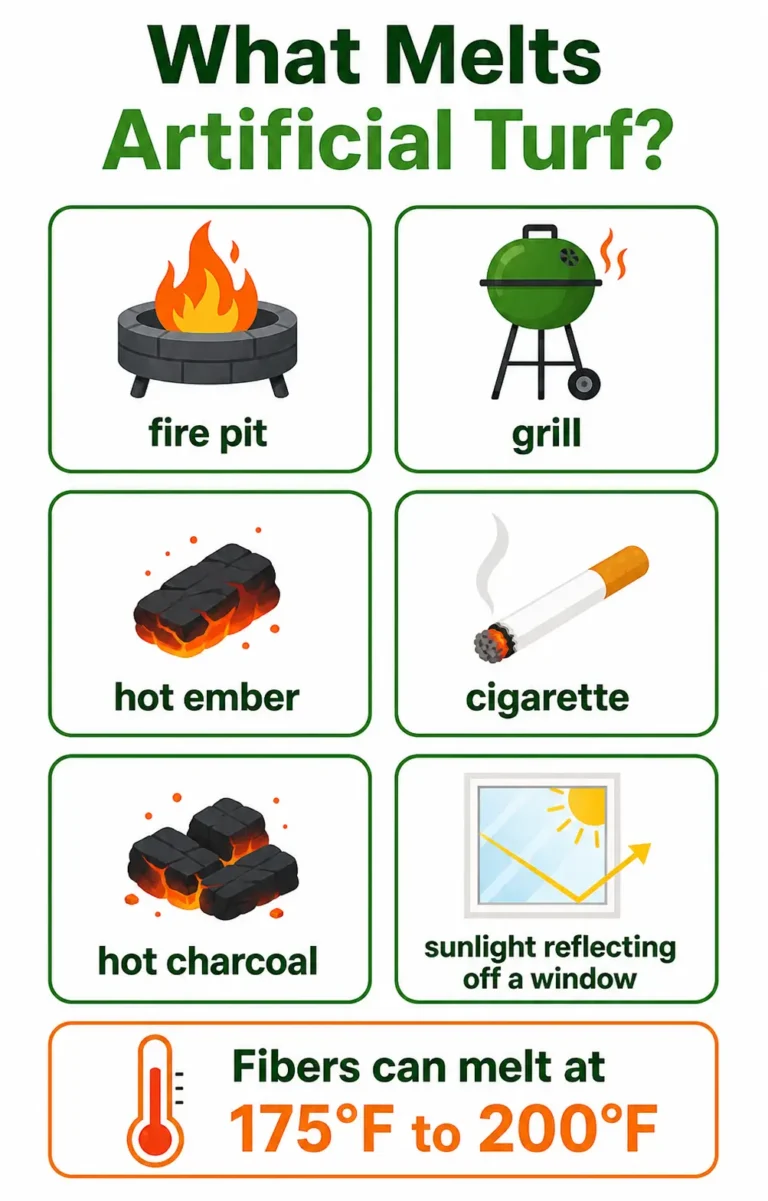
Fire pits and grills cause the most damage. The others below are smaller risks, but they are just as real.
- Fire pits and grills: radiant heat and falling coals melt fibers fast.
- Hot embers and sparks: each one can leave a small melted dot.
- Cigarettes: a lit butt burns a mark into the fibers.
- Hot charcoal: dumping coals on turf melts a patch right away.
- Lawn tools: a hot engine from a mower or trimmer can scorch turf if you set it down there.
- Concentrated reflected sunlight: shiny items or low-E windows can focus light into a hot spot.
Can You Put a Fire Pit on an Artificial Turf?

No. Do not place a fire pit directly on artificial turf. Direct heat can melt the fibers quickly. Falling embers can leave spots around it too. Melting plastic also gives off smoke and fumes that are unhealthy to breathe.
Build a separate non-combustible surface for the fire zone. That means a surface that does not burn. Good options include:
- Concrete: lasts the longest and handles heat well.
- Pavers: a stable base that keeps the fire away from the turf.
- Compacted gravel: a lower-cost choice for a small or seasonal pit.
Make the pad wider than the pit, since heat and embers travel past the edge. Add a spark screen, and follow your local fire code for distance from fences and walls. A paver patio next to your lawn does this job well. See our concrete pavers service if you want the turf and the hard surface planned together.
What Does Fire-Resistant Artificial Turf Mean?
Product pages mix up three terms. Here is what each one means:
- Fireproof: the material cannot burn or melt at all. No synthetic turf meets this bar.
- Fire-resistant: the product resists ignition and limits flame spread.
- Flame-retardant: the product is made or treated to go out when the flame is removed.
Be wary of any ad for fireproof artificial grass. Plastic fibers melt under enough heat, so no turf earns that label honestly.
A label that reads artificial grass fire resistant tells you how the turf handles ignition and flame spread. It does not promise the turf survives direct flame. Fire-resistant artificial grass still melts if you set a fire pit on it.
How Can You Check an Artificial Turf's Fire Rating?
Ask for proof, not just a label. Check these four things:
- The product sheet from the maker.
- The manufacturer documentation, including the fire-test report or test certification.
- The fire-rating standard named on that report.
- Whether the rating fits the way you plan to use the turf.
ASTM E108 Class A is a common example. ASTM E108 is a fire test for roof coverings. Some turf makers use it to show a product resists flame spread, and Class A is the highest of its three classes. Some labels say Class 1 instead, so ask which test sits behind that term.
A fire rating is a lab result. It does not mean the turf will not melt.
Is Artificial Turf Safe in a Fire-Prone Area?
Artificial turf does not dry out into kindling like a brown lawn. That helps near open space. But it is plastic, and wildfire embers can still melt it. Dry leaves or brush on top of it can burn too. Embers travel far, so ember exposure is the main risk in a wildfire.
So is artificial turf flammable enough to worry about in a fire-prone area? The risk is lower than with a dry lawn, but it is not zero. Turf alone does not create defensible space, which is a buffer cleared of things that burn. Keep dry vegetation and leaf litter off the turf and away from it. Certified fire-rated turf, such as Class A, is made to resist ember ignition, so ask for the report in high-risk areas.
San Diego has its own rule. Zone 0 covers the first 5 feet around a home in very high fire zones. The City of San Diego’s Zone 0 guidelines say turf on existing homes must stay at least 2 feet from decks, stairs, and walls. Enforcement for existing homes starts February 28, 2027, and the guidelines can change. Rules differ by city, so check with your local fire department. CAL FIRE’s Ready for Wildfire site also explains the defensible space zones.
How to Protect Artificial Turf From Heat and Fire
- Keep fire pits on a separate hard pad, never on the turf.
- Set grills on concrete, pavers, or another hard surface.
- Never leave hot charcoal or embers on the turf. Let ashes cool in a metal container.
- Keep cigarettes and other hot items off the grass.
- Let mowers and trimmers cool before you set them on turf.
- Move shiny items or shade the window if reflected sunlight burns a spot.
- Pick sand or quartz sand infill. It soaks up heat and cools the fibers. Crumb rubber can burn.
- Choose turf with documented fire tests when fire safety matters.
So, is artificial turf flammable? It resists fire, but it melts under heat. Plan for the heat sources in your yard, and your lawn will last.
Planning a lawn near a fire pit or in a fire-prone area? SD Home Turf can plan the turf and the hard surface together.
FAQ
What happens if an ember lands on artificial turf?
A small ember usually leaves a tiny melted or scorched spot. Quality turf tends to go out on its own, so the damage stays local. Brush the ember off fast and check the spot once it cools.
Does artificial turf melt in the sun?
Normal sunlight will not melt it. Light bounced off low-E windows or shiny items can focus heat and melt a small patch.
Is smoke from melting turf harmful?
Melting plastic gives off smoke and fumes that are unpleasant and unhealthy to breathe. Move away, ventilate the area, and call the fire department if flames spread.
What should I do if my turf melts?
Replace the damaged section with matching turf. Melted fibers cannot be fluffed or fixed back. Heat damage is usually not covered by a warranty, so check yours.