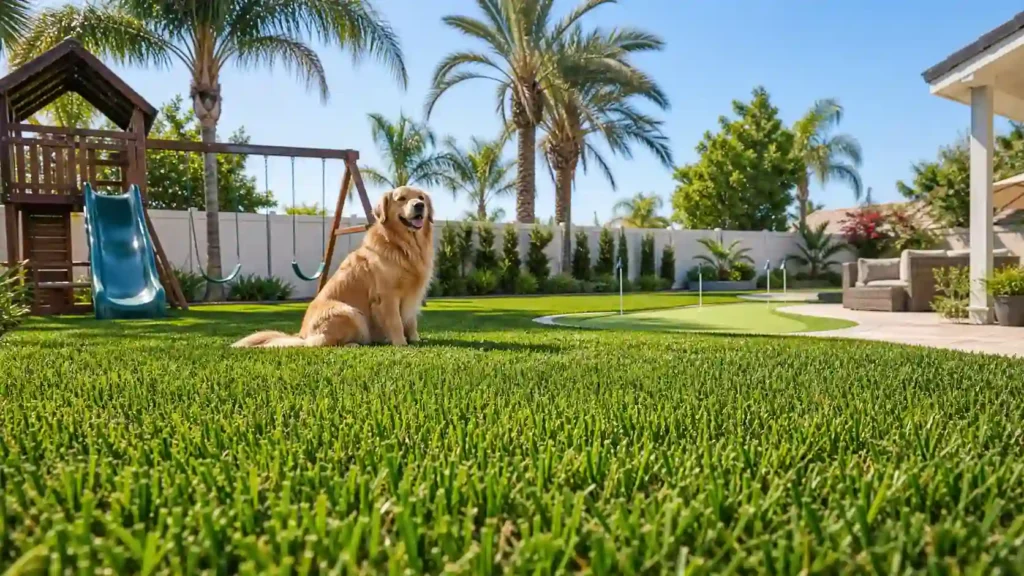
How to choose the right artificial grass: a green backyard lawn with a golden retriever, swing set, slide, and putting green
Turf Selection

How to Choose the Right Artificial Grass for Your Yard

How to choose the right artificial grass comes down to one thing: how you plan to use your yard. Match your intended use and traffic to the turf’s build, not to one number like pile height. Dogs, kids, and busy lawns each need a different artificial turf. Synthetic turf varies a lot, and the wrong pick can flatten, fade, or hold water. This guide covers pile height, blade shape, density, color, backing, UV resistance, durability, infill, and drainage. It also shows how artificial turf quality looks in a sample and how the different types of artificial turf fit each use. Start With Intended Use and Foot Traffic Choosing the right artificial grass starts with your yard, not the product page. Ask who will use the space and how often. That answer tells you which specs matter most. Traffic comes in three levels. Light traffic is a front lawn people mostly look at. Moderate traffic is normal family use. Heavy foot traffic is kids, dogs, and daily play in high traffic areas. More use means more wear and tear. Repeated steps cause matting, where blades tangle and stay down. They also cause flattening, where blades lean over and stop standing up. Turf built for your use resists both, which protects its durability. Your use also points to a turf type. Residential turf suits everyday yards. Pet turf is built for dogs. Playground turf is built for children and play areas. Intended use What to prioritize Residential yard Appearance, comfort, density, durability Pet area Drainage, infill, durability Children’s area Durability, drainage, safe surface feel High traffic Density, blade shape, durability Picture a yard with two dogs and a swing set. It needs the pet row and the children’s row, so check drainage and durability first. Compare Pile Height and Density Choose Pile Height Based on Use Pile height is the blade length, measured from the backing to the tip. It sets how the lawn looks and feels underfoot. Taller blades look lush and more like natural grass. Shorter blades stay upright longer and resist matting. Most residential lawns use a pile near 1.5 to 2 inches. Pet areas often run shorter, near 1 to 1.5 inches. Sports fields and putting greens still use shorter piles. Taller is not better. Very tall blades can lean over under traffic. Look at spring-back, which is how fast blades stand up after you step on them. Blade length alone says little about quality. Look at Density, Not Just Height Density is how many fibers are packed into the turf. Dense turf looks full, hides the backing, and handles heavy foot traffic well. Face weight is the weight of the turf fibers in one square yard, not counting the backing. Most residential turf falls between 50 and 80 ounces. Stitch rate counts the stitches along each row. Gauge is the space between rows. More stitches and a tighter gauge mean more turf fibers in every square foot. The yarn is the plastic strand that forms each blade. Never trust one number. A tall, light turf can look thin and flatten fast. A shorter, dense turf can look better and last longer. Artificial turf quality shows up when density, face weight, and pile height work together. Try a simple test. Press your hand into a sample and lift it. Good turf stands back up fast. Poor turf stays down. Compare Blade Shape and Color Choose a Blade Shape That Fits the Look and Use Blade shape, also called blade profile, is the cross-section of each fiber. It affects how blades bend, recover, and catch light. Resilience is how well a blade bounces back after use. C-shaped blades curve inward, which helps them spring back. S-shaped blades add body and a natural, random lean. W-shaped blades are stiff and stand up well under traffic. Flat blades are simple and often look shiny. Judge blade shape with density and pile height, not on its own. Marketing names mean little. Ask for the fiber shape, then check how the turf fibers behave in a sample. Choose a Natural-Looking Color Real grass is not one flat green. Look for multi-tone yarn that mixes light and dark greens. Thatch adds to this. It is a layer of short tan or brown fibers at the base that mimics the dead blades in a real lawn. Olive and field greens give the most natural appearance in most yards. Bright neon green looks fake. A glossy sheen in direct sun gives it away too. Color is a visual choice, not a quality score. Pick the shade you like. Then compare turf samples outside, in your yard’s light, side by side. Online photos hide color shifts. The best and worst artificial grass can look close on a screen, but a sample shows the difference. Check the Backing and Drainage Understand the Turf Backing Backing is the layer under the fibers that holds them in place. Most turf has a primary backing, where the fibers are stitched. A secondary backing is a coating that locks those stitches down. Common coatings are polyurethane and latex. Bind strength tells you how firmly fibers grip the backing. Weak bind lets fibers pull out and shed. Backing also gives the turf stability, so it lies flat and keeps its shape. For outdoor use, choose turf with permeability, which means water can pass through it. A thin or brittle backing is a red flag. Check How Water Moves Through the Turf Water flow through artificial turf depends on the backing and the base under it. For the full picture, read How Does Artificial Turf Drain Water? Good drainage moves rain and pet urine down and out. Hole-punched backing has drainage holes spaced across the sheet. Flow-through backing lets water pass across the whole surface, so it drains faster. Choose turf with drainage that matches your use. A dog run or play area sees far more liquid than a front lawn. Evaluate UV Resistance and Durability Look for UV Resistance UV resistance is