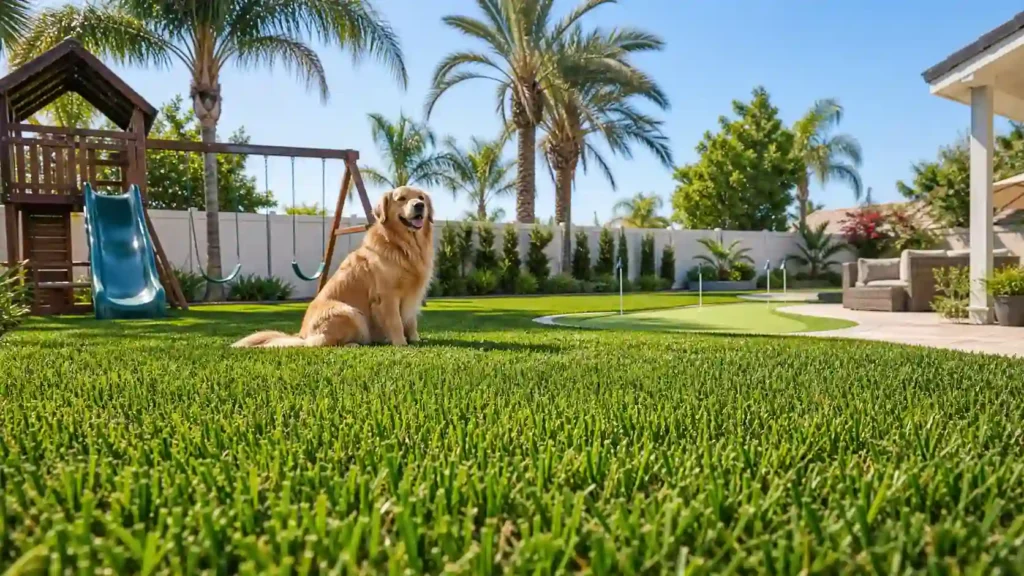
How to choose the right artificial grass comes down to one thing: how you plan to use your yard. Match your intended use and traffic to the turf’s build, not to one number like pile height. Dogs, kids, and busy lawns each need a different artificial turf. Synthetic turf varies a lot, and the wrong pick can flatten, fade, or hold water.
This guide covers pile height, blade shape, density, color, backing, UV resistance, durability, infill, and drainage. It also shows how artificial turf quality looks in a sample and how the different types of artificial turf fit each use.
Start With Intended Use and Foot Traffic
Choosing the right artificial grass starts with your yard, not the product page. Ask who will use the space and how often. That answer tells you which specs matter most.
Traffic comes in three levels. Light traffic is a front lawn people mostly look at. Moderate traffic is normal family use. Heavy foot traffic is kids, dogs, and daily play in high traffic areas.
More use means more wear and tear. Repeated steps cause matting, where blades tangle and stay down. They also cause flattening, where blades lean over and stop standing up. Turf built for your use resists both, which protects its durability.
Your use also points to a turf type. Residential turf suits everyday yards. Pet turf is built for dogs. Playground turf is built for children and play areas.
Intended use | What to prioritize |
Residential yard | Appearance, comfort, density, durability |
Pet area | Drainage, infill, durability |
Children’s area | Durability, drainage, safe surface feel |
High traffic | Density, blade shape, durability |
Picture a yard with two dogs and a swing set. It needs the pet row and the children’s row, so check drainage and durability first.
Compare Pile Height and Density
Choose Pile Height Based on Use
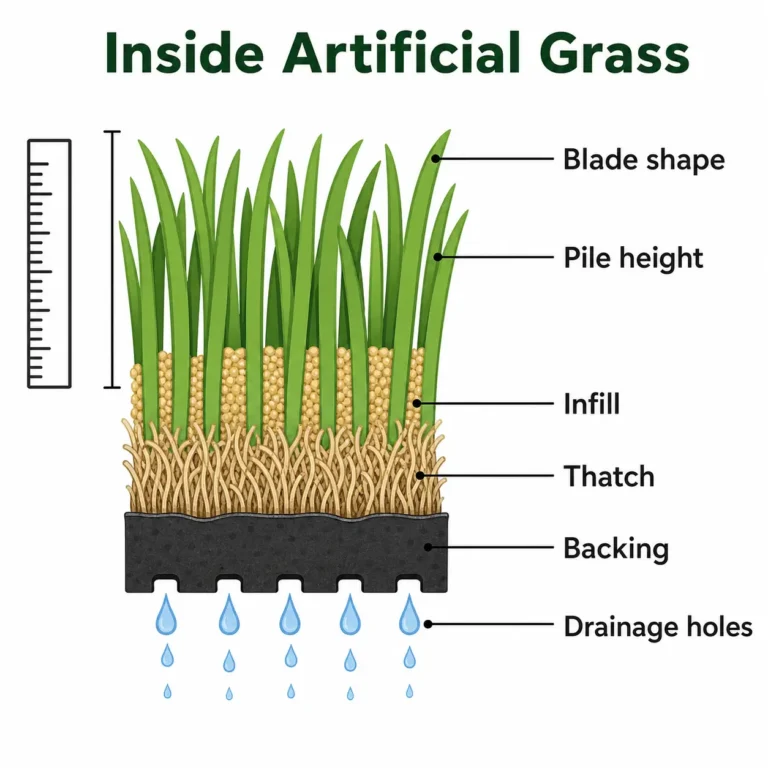
Pile height is the blade length, measured from the backing to the tip. It sets how the lawn looks and feels underfoot.
Taller blades look lush and more like natural grass. Shorter blades stay upright longer and resist matting. Most residential lawns use a pile near 1.5 to 2 inches. Pet areas often run shorter, near 1 to 1.5 inches. Sports fields and putting greens still use shorter piles.
Taller is not better. Very tall blades can lean over under traffic. Look at spring-back, which is how fast blades stand up after you step on them. Blade length alone says little about quality.
Look at Density, Not Just Height
Density is how many fibers are packed into the turf. Dense turf looks full, hides the backing, and handles heavy foot traffic well.
Face weight is the weight of the turf fibers in one square yard, not counting the backing. Most residential turf falls between 50 and 80 ounces. Stitch rate counts the stitches along each row. Gauge is the space between rows. More stitches and a tighter gauge mean more turf fibers in every square foot. The yarn is the plastic strand that forms each blade.
Never trust one number. A tall, light turf can look thin and flatten fast. A shorter, dense turf can look better and last longer. Artificial turf quality shows up when density, face weight, and pile height work together.
Try a simple test. Press your hand into a sample and lift it. Good turf stands back up fast. Poor turf stays down.
Compare Blade Shape and Color
Choose a Blade Shape That Fits the Look and Use
Blade shape, also called blade profile, is the cross-section of each fiber. It affects how blades bend, recover, and catch light. Resilience is how well a blade bounces back after use.
C-shaped blades curve inward, which helps them spring back. S-shaped blades add body and a natural, random lean. W-shaped blades are stiff and stand up well under traffic. Flat blades are simple and often look shiny.
Judge blade shape with density and pile height, not on its own. Marketing names mean little. Ask for the fiber shape, then check how the turf fibers behave in a sample.
Choose a Natural-Looking Color
Real grass is not one flat green. Look for multi-tone yarn that mixes light and dark greens. Thatch adds to this. It is a layer of short tan or brown fibers at the base that mimics the dead blades in a real lawn.
Olive and field greens give the most natural appearance in most yards. Bright neon green looks fake. A glossy sheen in direct sun gives it away too.
Color is a visual choice, not a quality score. Pick the shade you like. Then compare turf samples outside, in your yard’s light, side by side. Online photos hide color shifts. The best and worst artificial grass can look close on a screen, but a sample shows the difference.
Check the Backing and Drainage
Understand the Turf Backing
Backing is the layer under the fibers that holds them in place. Most turf has a primary backing, where the fibers are stitched. A secondary backing is a coating that locks those stitches down. Common coatings are polyurethane and latex.
Bind strength tells you how firmly fibers grip the backing. Weak bind lets fibers pull out and shed. Backing also gives the turf stability, so it lies flat and keeps its shape. For outdoor use, choose turf with permeability, which means water can pass through it. A thin or brittle backing is a red flag.
Check How Water Moves Through the Turf
Water flow through artificial turf depends on the backing and the base under it. For the full picture, read How Does Artificial Turf Drain Water?
Good drainage moves rain and pet urine down and out. Hole-punched backing has drainage holes spaced across the sheet. Flow-through backing lets water pass across the whole surface, so it drains faster. Choose turf with drainage that matches your use. A dog run or play area sees far more liquid than a front lawn.
Evaluate UV Resistance and Durability
Look for UV Resistance
UV resistance is the fibers’ ability to handle direct sunlight without fading. UV stabilization is a treatment added to the yarn when it is made. Good UV protection slows fading and keeps color steady for years.
Sunlight is strong in San Diego County, so a UV resistant yarn matters here. Match UV protection to your sun. A full-sun yard needs strong UV stabilization. A shaded side yard has more room. Ask the seller how the yarn is treated and what the warranty says about fading.
Judge Durability From the Whole Turf System
Durability is how long turf keeps its look and shape under use. No single spec decides it. Weigh pile height, density, blade shape, backing, UV resistance, and traffic together. Matting is the clearest sign that the build did not match the use.
Yarn type matters too. Polyethylene is the most common choice for yards. It is soft and looks lifelike. Nylon is the strongest and costs more. Polypropylene costs the least and fades fastest. Turf that matches your traffic handles wear and tear better. For what to expect over the years, see How Long Does Artificial Turf Last?
Do not assume the heaviest or priciest turf is right. A premium turf on a quiet lawn adds cost without adding benefit.
Choose the Right Infill
Infill is the granular fill spread between the blades. It holds the turf fibers upright, adds weight so the turf lies flat, and steadies the surface. Different uses need different infill, and no single type is right for every yard.
Silica sand is the common, low-cost choice. Coated sand adds extras. Antimicrobial sand has a coating that fights odor-causing bacteria. Zeolite is a mineral that absorbs pet odors, and it works best on top of a base infill. In pet turf, pick infill that fights odor and does not trap urine.
Rubber infill gets hot in strong sun, and some buyers skip it for eco friendly reasons. Sand and zeolite are natural minerals. Heat also depends on the fiber. Penn State’s Center for Sports Surface Research tested 11 fiber and infill combinations and found that surface heat differed between them, so ask which pair your turf uses. The full test is in their heat evaluation report.
Types of Artificial Grass: Match the Turf to Your Intended Use

Now you know how to choose the right artificial grass spec by spec. Here is how those specs combine in the four main types of artificial grass. Artificial turf options narrow fast once you know your use.
Residential Turf
Residential turf, also called landscape turf, is built for looks and comfort in a typical residential yard. It handles moderate traffic. Aim for a pile near 1.5 to 2 inches, solid density, multi-tone color, strong UV protection, and good drainage. See our Residential Artificial Turf Installation in San Diego service.
Pet Turf
Pet turf is built for dogs. Pets bring repeated traffic, pet urine, and pet waste. Choose a shorter pile, tough fibers, flow-through backing, and infill that helps with odor control. Pet friendly turf focuses on drainage and durability first. Remove solid waste and rinse the area to keep it fresh. For more on wear, read Can Dogs Damage Artificial Turf? See our Artificial Pet Turf Installation in San Diego County service.
Playground Turf
Playground turf is built for children and constant play. A play area gets repeated traffic, so durability and drainage matter most. Many play areas add a cushioning layer under the turf. For details, see Does Artificial Grass Need an Underlay?
Safety adds a second layer. The U.S. Consumer Product Safety Commission names falls as the largest single hazard on playground equipment in its Public Playground Safety Handbook. The ASTM F1292 standard sets impact performance rules for playground surfacing, shown as a critical fall height. You can read the ASTM F1292 standard online. Choose the turf for the play area, not for softness alone. See our Playground Turf Installation in San Diego County service.
Putting Green Turf
Putting green turf has a different goal: a smooth, true putting surface. The pile is short, often about half an inch, and the fibers are dense and even. Fine sand infill supports ball roll. A consistent surface gives the same speed across the whole green. Each use has its own build, so do not pick landscape-style turf for a green. See our Artificial Turf Putting Green Installation in San Diego County service.
Not sure which turf fits your yard? SD Home Turf offers artificial turf installation across San Diego County. Our licensed team will help you match the specs to your yard and your use. Call or text (619) 273-3088 today and get a free consultation.
Use This Artificial Grass Selection Checklist
Use this list when you compare products. It turns how to choose the right artificial grass into one clear decision.
Check These Specifications
- Intended use and traffic level
- Pile height that fits the use
- Blade shape and fiber type
- Density and face weight
- Color seen in your own light
- Backing with strong bind and permeability
- UV resistance for your sun
- Durability across the whole system
- Infill that fits the use
- Drainage that matches the water load
Ask Yourself These Before Choosing
- How will the yard be used?
- How much traffic will the turf get?
- Will pets use it?
- Will children use it?
- How much direct sun will it get?
- How important is drainage?
- What look do you want?
- Does the turf’s build match its intended use?
Artificial Grass Selection FAQs
What is the most important factor when choosing artificial grass?
Intended use and traffic come first. Then pick the specs that fit that use.
How do I tell if artificial grass is good quality?
Judge the whole build, not one number. Check density, blade shape, backing, and UV resistance, and do the press-and-release test on a sample.
How do I choose the right pile height for artificial grass?
Match it to traffic and looks. Lawns look best with taller blades, while pet areas and putting greens need shorter ones.
Is higher-density artificial grass better?
Not always. Density helps in heavy use, but it works best balanced with pile height and blade shape.
What should I look for in artificial turf backing?
Look for permeable backing, strong bond strength, and a firm coating. Poor backing leads to shedding and water problems.
What type of artificial grass is best for pets?
Choose flow-through backing, tough fibers, and infill that fights odor. Fast drainage matters most.
What type of artificial grass is best for children?
Choose durable, well-draining turf with a cushioned, tested surface. Match it to the play area and the equipment.