
A backyard putting green needs a compacted subgrade, a compacted crushed aggregate base, and a thin finishing layer of decomposed granite or screenings. Each layer must be graded and compacted with care. That is the short answer to what base does a backyard putting green need, and it applies to every artificial putting green.
The exact depth and material can change with your soil, drainage, and green design. The goal stays the same: a firm, smooth base that gives true ball roll. Our guide to backyard putting green installation covers the full build.
What Layers Go Under an Artificial Putting Green?
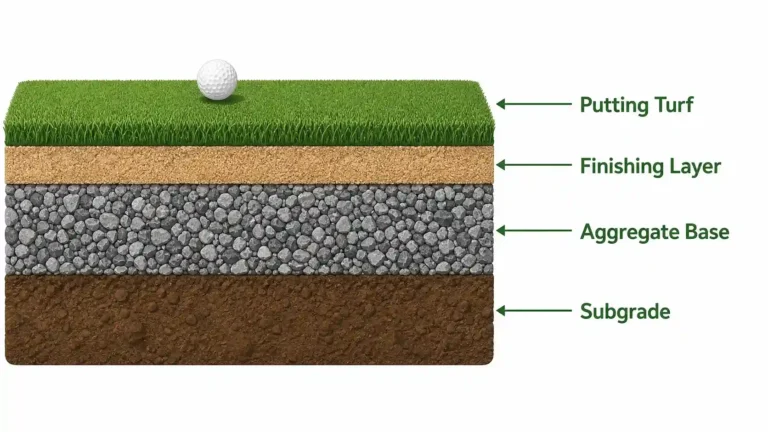
Three layers sit under the turf. Each one has a job. Skip one, and the surface will show it.
Prepared Subgrade
The subgrade is the native soil under your green. Crews excavate to the needed depth, then shape and firm the soil. Soft or wet spots must be fixed before any rock goes in. Remove them and replace them with firm fill. A weak subgrade cannot hold up even a perfect base.
Compacted Aggregate Base
This is the main base layer. It is made of crushed aggregate, often called crushed rock. The pieces are angular, so they lock together when compacted. That locking action builds a stable platform that does not shift with foot traffic or rain. It works like an artificial turf sub-base, but a putting green asks for more of it.
Fine Finishing Layer
A thin layer of decomposed granite or fine screenings goes on top of the crushed rock. It fills the gaps between larger stones. It also allows fine grading, which means shaping the surface to the exact height and slope you want.
Purchase Green uses about a quarter inch of decomposed granite over crushed rock in its putting green guides. The USGA also describes finer screenings over aggregate to shape contours.
Why Does the Base Matter So Much for Putting?

The chain is simple. A stable base creates a smooth surface. A smooth surface gives true ball roll.
A putting green uses short-pile turf. The short pile has little height to hide flaws. A normal artificial lawn can hide small uneven spots. A rolling golf ball cannot ignore them.
Here is what a poor base causes:
- Soft spots sink under weight and leave dips.
- Low spots pull the ball off line and hold water.
- Bumps push the ball sideways.
- Uneven compaction leads to settlement, so the green changes shape over time.
Contours add another need. Slopes and breaks are shaped in the base, not in the turf. If the base is off, the breaks will not roll the way you planned. The turf only copies what sits below it.
How Deep Should the Base Be?
There is no single depth for every putting green. Depth depends on your soil, your design, and the system used. Four numbers add up to the total build-up: the excavation depth, the aggregate thickness, the finishing layer thickness, and the finished grade.
Published specs show the range. Purchase Green lists excavating 3 to 5 inches of native soil. Its basic green uses 4 inches of crushed rock plus a quarter inch of decomposed granite. Its premium version uses only 2 inches of rock before the bender board goes in. A builder quoted by the USGA described 2 to 4 inches of gravel with 6 to 8 inches of compacted aggregate above it. Treat these as examples, not rules.
Finished elevation matters too. The top of the green must line up with edges like a concrete patio. Weak or soft soil often calls for more base. Firm soil may need less. A good installer sets the total build-up after checking your site.
How Should a Putting Green Base Be Compacted and Finished?
A putting green base needs more than casual leveling. This is what the careful version looks like:
- Compact the aggregate. Use a plate compactor. Purchase Green calls for 90 to 95 percent compaction on its crushed rock.
- Work in lifts. When the base is thick, add and compact it in layers.
- Check the grade. Test the surface after each pass.
- Screed the fine layer. Drag a straight edge across it to cut high spots and fill low spots.
- Build in the contours. Shape every slope and break before the turf goes down.
- Inspect the finished surface. Walk it and look for any dip or bump.
Surface tolerance is tight on a putting green. Fix every high spot and low spot now. They are far harder to fix once the turf is glued down.
Does a Backyard Putting Green Base Need Drainage?
Yes. The base and finished grade must work with your site’s drainage.
Most artificial putting greens use surface drainage. Water runs across the top and off the edges. The USGA describes a slight turtle-back shape that sheds water and helps prevent algae. Build that slope into the base, and avoid low spots where water can pool.
Your soil matters here. Sandy soil drains fast. Clay holds water and needs more care. Watch how water flows across your yard before you plan the green.
What Is the Best Base for an Artificial Putting Green?
The best base for artificial putting green projects is not one special rock. It is a complete system. It must be stable, graded with care, able to shed water, and smooth under the putting turf.
Most systems use crushed aggregate as the structural base. A finer layer of decomposed granite or screenings goes on top for shaping and smoothing. The right mix and thickness depend on your site and design. A base for backyard putting green builds should be judged by how the surface plays, not by the name of the rock.
Getting this right takes skill and the right tools. SD Home Turf has built putting greens across San Diego County for over 10 years, and base work gets the most care on every job. If you want it done right, see our putting green installation in San Diego County page, or visit SD Home Turf to request a free consultation.
FAQs
Can I use a regular artificial turf base for a putting green?
The materials can be similar. The work is not. A putting green needs tighter grading, firmer compaction, and a smoother finish, because ball roll exposes every flaw.
How thick should a putting green base be?
There is no single thickness. Published systems range from a few inches to over 10 inches in total. Your soil, materials, and finished elevation set the right depth.
Does decomposed granite go under putting green turf?
Yes, in many systems. A thin layer of decomposed granite sits over the crushed rock as a fine finishing layer. It helps create a smooth, even surface for the turf.