
Here is how to cut artificial grass cleanly without damaging the blades. Let the turf relax, then turn it so the backing faces up. Cut between the stitch rows with a sharp utility knife, using shallow passes. Leave a little extra until the fit checks out, then trim it in small steps.
This guide also covers the best tools, edges and curves, and how to roll and store turf. You will learn how to move it without permanent creases.
How to Handle and Unroll Artificial Grass Before Cutting
Good cuts start before the knife comes out. Rough handling creates problems that no blade can fix.
Support the turf roll along its length while you move it. Keep the core end level so the roll does not sag. Never drag it over rough ground, because that scratches the backing and snags the fibers.
Unroll the turf onto a clean, flat surface, like a swept driveway or patio. Unroll it slowly instead of forcing it flat. Wrinkles and curls are normal at first. Pros call this settling period acclimation. Warm sun speeds up relaxation, and an hour or two often does the job. Go by the turf, not the clock, and follow your turf maker’s guide.
If a crease or kink shows up, do not bend it hard the other way. The backing can hold the bend. Let the sun and time soften it instead.
Keep every piece facing the same pile direction so the color looks even. Leave the excess material along the edges until your final fit. Keep heavy items off the fibers, since compression can flatten the pile.
What Is the Best Tool for Cutting Artificial Grass?
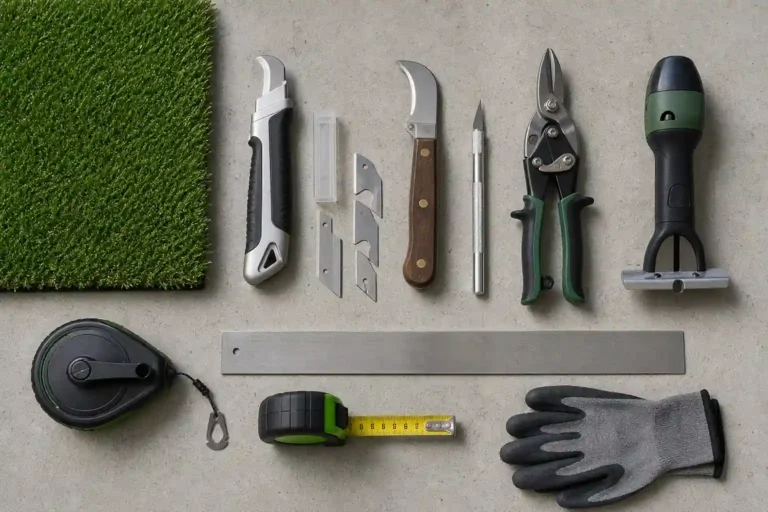
A sharp utility knife with a fresh blade is the best all-round choice. The best tool for cutting artificial turf is simply the sharpest one you have. A dull blade tears fibers and slows the job. Swap in a new blade as soon as it drags instead of slicing.
Tool | Best for |
Utility or turf knife (a hook blade adds control) | Most straight and curved cuts |
Fresh replacement blade | Clean cuts with no torn fibers |
Carpet knife | Heavy backing and long lines |
X-Acto knife | Small, fine detail |
Shears or snips | Small trims and tight spots |
Push cutter | Long runs and smooth curves |
Add a chalk line, a straight edge, a measuring tape, and gloves. Gloves matter. OSHA says the biggest hand tool hazards come from misuse and poor upkeep, so keep your blades sharp and your hands covered.
How to Cut Artificial Grass Cleanly

The best way to cut artificial grass is slowly, from the back, one shallow pass at a time. Cutting is one step in the complete artificial grass installation guide, but it is the step you cannot undo.
- Unroll and relax the turf. Get it reasonably flat. Let major curls settle before you measure.
- Mark the cut. Measure twice. Snap a chalk line or trace along a straight edge. Let the turf run slightly past your edges, and keep the excess turf.
- Expose the backing. Flip the turf, or fold the edge back, so the backing faces up. Cutting from the back keeps your knife away from the visible fibers.
- Follow the stitch rows. Find the straight rows of stitching on the backing. Guide the knife between them. Cutting through stitches can loosen tufts. If two pieces meet, keep the same row spacing on both.
- Make shallow passes. Use a sharp utility knife and extend the blade only a fraction of an inch. Pull the excess up and back as you cut. This keeps the material taut and stops bunching. Never force the knife.
- Test fit and trim. Lay the piece in place and check it. Remove small amounts at a time. Leave a gap of about 1/8 to 1/4 inch at hard borders, like patios and fences. That gap gives the turf room to expand in the sun. Gap size can vary by product, so check your turf maker’s guide and the Synthetic Turf Council’s installation guidelines.
How to Cut Artificial Grass Around Edges and Curves
Most yards have more than straight lines. These cuts need patience, not force.
Straight edges
Walls, fences, patios and pavers all need a tight but gentle fit. Fold the extra turf away from the edge and cut in short segments. After every few inches, lay the turf back to check the fit. Do not take the whole edge off at once. Narrow strips are trickier. If you plan to install artificial grass between pavers, cut each strip a little long and trim it to fit the gap.
Curves and rounded edges
If you wonder how to cut artificial turf along a curve, start by marking the line with chalk. Make a starter cut at the beginning of the line so the knife has a path. Then use small, controlled cuts that follow the radius. A push cutter glides well along a curve once the turf is slit. Stop often and check the shape. A smooth curve looks far better than a jagged one.
Fixed obstacles
Pipes, posts and tree trunks need an opening that fits snugly. Cut a straight line from the edge to the obstacle. Then cut a small X where it sits and slip the turf over. Trim the opening piece by piece and enlarge it a little at a time. One big cut can ruin a fresh piece. On turf that is already installed, sweep the infill away from the cut line first. That protects your blade.
Big curves or many pieces can eat up a whole weekend. If you want a clean finish without the guesswork, see our artificial turf installation in San Diego County.
How to Fold, Roll and Store Artificial Grass Without Permanent Creases
For longer storage, rolling beats folding. A tight fold can leave a permanent crease in the backing, and creases often show in the finished lawn.
Roll the turf loosely and evenly around a sturdy core. Keep the roll straight and avoid any kink. Skip tight folds, and never leave a hard crease sitting for weeks.
Pick a dry storage spot. Moisture trapped in the roll can lead to musty smells and mold. Lay the roll flat on a clean, dry surface so it stays supported and does not collapse or bend. Protect the edges and backing from sharp objects. Keep heavy items off it too, since long-term compression can crush the pile.
How to Transport Artificial Grass Without Creasing It
Moving turf is a lot like storing it, only with more bumps. Keep the turf roll firm, but not squeezed. Support it along its length during transportation. Secure it with wide straps, and snug them without cranking them down. Over Tighten straps leave compression marks.
Keep heavy materials off the roll, and avoid any sharp bend while you load it. Cover it with a tarp to shield the backing from rain and rough surfaces.
Common Artificial Grass Handling and Cutting Mistakes
A few habits cause most of the trouble.
Mistake | Better approach |
Using a dull blade | Swap in a fresh blade when it drags |
Cutting from the grass side | Cut from the backing side |
Cutting through stitch rows | Guide the knife between the rows |
Cutting to final size at once | Leave excess turf, then trim a little at a time, since excessive trimming cannot be undone |
Cutting before wrinkles settle | Let the turf relax first |
Dragging turf over rough ground | Lift and carry it |
Tight folding, which can leave a permanent crease | Roll it for storage |
A compressed roll under heavy loads | Keep the roll supported with nothing on top |
FAQs
Can you cut artificial grass with a regular utility knife?
Yes. A regular utility knife works well when the blade is fresh. A hook blade gives extra control on long lines.
What can I use to cut artificial grass?
Start with a utility knife. Add snips for small trims, an X-Acto knife for fine detail, and a push cutter for long runs and curves.
Is it better to cut artificial grass from the front or back?
Cut from the back. You can see the stitch rows there, and the visible fibers stay safe. Cutting from the front slices the pile and hides your guide lines.
Can you fold artificial grass for storage?
For a short time, a wide, loose fold is fine. For anything longer, roll it. Sharp folds can leave creases that stay.