

The best backyard putting green ideas depend on your space, golf goals, and yard layout. A small yard can use a corner, narrow, or kidney-shaped green. A larger yard can fit several cups, gentle slopes, a chipping area, a bunker, or a more playful design.
Think about three things first: where the green will fit, how you want to practice, and how it should work with the rest of your yard. From there, you can choose the right shape, holes, contours, fringe, turf, and other features. Every idea below works with an artificial putting green as the surface. You will see small-space layouts, shape-based designs, practice-focused greens, garden-friendly looks and feature-rich builds.
Small-Space Layouts That Use Every Foot
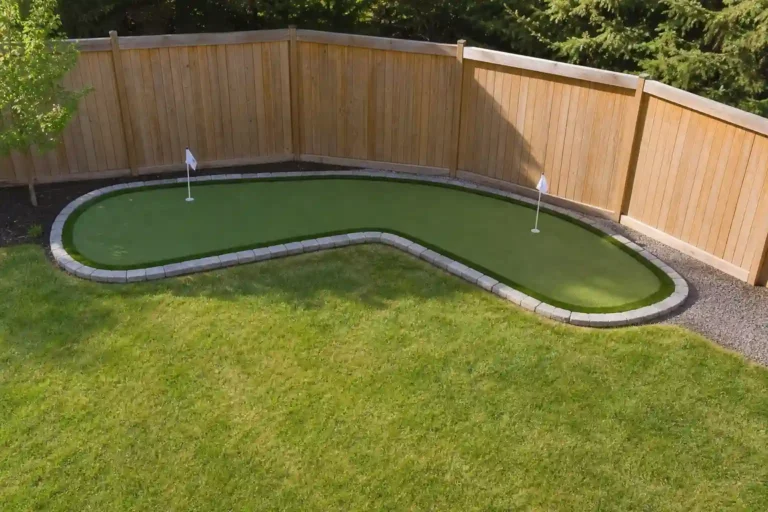
Corner Greens
An unused corner is a smart place to start your putting green design. An L-shaped or triangular footprint fills the corner and leaves the rest of the yard open. A corner suits an artificial putting green in backyard spaces that are too tight for a full lawn.
Plan one or two cups, and keep each cup well away from the edge. Hole placement matters more than raw size when space is tight. To keep the green from feeling cramped, curve the open edge and keep the middle clear. For small backyard putting green ideas like this, a short, clean layout beats a crowded one.
Narrow Side-Yard Greens
A side yard turns a dead strip into a practice lane. Run the green along a fence line or beside a walkway for long putting strokes. A narrow green trades width for length, which suits players who want to work on pace.
An elongated green helps with distance control, since you can roll putts from 10, 15 or 20 feet. For example, in a side yard 10 feet wide, a green 5 feet wide leaves a 5-foot path beside it. Add a cup at each end, and you can put in both directions.
Shape-Based Designs

Putting green shapes changes how each putt plays and how much room you need. Each shape below follows the same four checks, so you can compare them fast.
Oval or Circle
- Best for: players who want a simple layout and straight practice runs.
- Layout advantage: an oval has no tricky corners, so it fits most flat yards.
- Practice advantage: a long lane across the middle gives you steady speed practice.
- Limit: it offers few angles, so putts can feel alike after a while.
Kidney
- Best for: yards with curved beds, patios or odd corners, where a curved layout looks natural.
- Layout advantage: the kidney shape fits irregular spaces and blends with garden lines.
- Practice advantage: hole placement at opposite ends gives you different putting angles, with one long and one short putt.
- Limit: tight curves can hide the line of a putt, so keep the bend gentle.
Figure-Eight
- Best for: wider yards that can hold two connected putting zones.
- Layout advantage: a narrow middle links the two zones and keeps the turf in one piece.
- Practice advantage: you can switch between short putts in each zone and long putts across both.
- Limit: the narrow middle can feel tricky, so watch the width there.
Free-Form
- Best for: wide yards where you want a green that looks like part of the garden.
- Layout advantage: soft, wavy edges match garden beds and stone borders.
- Practice advantage: wavy edges create more cup spots and new lines to read.
- Limit: curves take more time to cut and edge than straight lines.
Practice-Focused Layouts
The best backyard putting green designs match the shots you want to practice.
Gentle Slopes and Subtle Breaks
Gentle slopes add subtle breaks and make you read every putt. Keep the slope soft, because steep contours are hard to play and hard to build. Aim for rolls that bend the ball a few inches, not a few feet.
Rolls that run in more than one direction teach you to read breaks both ways. A small slope also helps water move off the turf. Too many contours make a green feel busy, so keep the design simple.
Tiered Sections
A tiered green adds height changes, with two or three levels linked by soft slopes. Compacted crushed stone or a small retaining wall can shape each step. Each tier gives you breaking putts that a flat green cannot match.
Tiers need careful contour planning, because the shape is built into the base under the turf. Before you lock in a design, read what base a backyard putting green needs.
Multiple Cups for Mixed Putts
Multiple holes can make a compact practice green feel much bigger. Set cups at different starting points so you face long putts, short putts and new breaks. Avoid crowding the holes, because balls need room to roll.
Two or three cups work well on most home greens, even small ones. Smart spacing gives you more practice than extra size does.
Short-Game Add-Ons: Fringe, Chipping Area and Bunker

Fringe and Rough
Real greens have a fringe, and your green can have one too. A fringe apron of 2 to 3 feet frames the green and gives you room to chip. Fringe turf has a longer pile height than the putting surface.
Dual-surface turf pairs a smooth putting turf with a taller, rougher turf around the edges. That taller turf lets you play from the rough. It also softens the look where the green meets the yard.
Chipping Area
A chipping area adds shot types that putting alone cannot teach. Bump-and-run shots start on the fringe and roll onto the green, much like real course play. A small tee box a few steps back lets you hit pitch shots too.
Chip shots put extra wear on turf, so ask your installer which turf and base can handle them.
Sand Bunker
A bunker lets you practice sand shots and high, soft pitch shots. It adds real challenge, but it needs more space and more upkeep than the green. Sand gets kicked out, so plan on raking and topping it up. Add a bunker only if your yard has room for the swing and the landing zone.
Designs That Blend Into Your Yard

A backyard putting green looks best when it feels like part of the yard. Think about how you will use the space for outdoor living, not only for golf.
Patio and Seating
Put the green beside a patio and it joins your outdoor living space. Guests can take a few putts while others sit and talk nearby. A bench or a few chairs by the green turns practice into a social spot.
Add a clean hardscape transition from patio to turf, and keep walkways clear of play. Check that rain drains away from the patio edge and off the turf.
Pavers, Decorative Rock and Edging
Concrete pavers make a neat border and a firm edge for the turf. Stone edging or decorative rock defines the shape and keeps the edge of the green tidy. A good border also shows off the curves of a kidney or free-form layout. Pick a border that sits flat, so nobody trips on it.
Garden Beds and Natural Stone
Plants, garden beds and natural stone soften the edges of the green. Keep low plants and decorative rock a few feet back so leaves stay off the turf. Natural stone gives a calm look next to the bright green surface. Keep the planting simple and let the green stay the focus.
Lighting for Evening Practice
Outdoor lighting lets you keep practicing after the sun goes down. Place lowlights around the edge of the green, not above the putting line. Aim each light away from your eyes so glare does not throw off your reading. String lights near the patio add mood without getting in the way of play.
Fun and Themed Designs
Mini-golf style greens add ramps, small tunnels and stone borders for family fun. Keep the obstacles removable, so you can switch back to serious practice. Links style uses rolling mounds, tall natural grasses and sand to echo a Scottish course. Both ideas need extra space and planning, so settle the basics first.
How to Pick the Right Idea
Use this quick guide to match your space and your goals.
Your situation | Best idea | Why it works |
Unused corner | L-shaped or triangular corner green | Fits tight space with one or two cups |
Side yard or fence line | Narrow, elongated green | Builds distance control |
Curved patio or garden beds | Kidney or free-form | Blends with the yard and offers new putting angles |
Wide yard | Figure-eight with multiple cups | Gives two zones for long and short putts |
Short-game practice | Green with fringe and chipping area | Adds chip and bump-and-run shots |
Family fun | Mini-golf style | Brings in ramps and tunnels |
Still unsure? Pick the shape first, then add the features.
Add Your Heading Text HerWhat to Plan Before You Builde
A little planning decides how well your chosen design will work. Slope and equipment access also shape what you can build, per guidance drawn from the USGA Green Section Record. Check these points first:
- Footprint: stake out the size with string or paint. Leave room to swing a putter near fences and walls.
- Hole placement: mark cup spots and keep them away from the edges.
- Contours: decide how much slope you want before any work starts.
- Surrounding yard: note sun, shade and trees, since leaves land on the turf.
- Drainage: avoid low spots, because standing water ruins a green.
- Access: crews and materials need a clear path into the yard.
- Practice style: choose putting only, chipping or family play.
- Turf: artificial putting green turf has a short pile height for a smooth roll. Permeable backing lets water drain.
Budget depends on size and design. Pro installs often run about $15 to $40 per square foot, according to HomeAdvisor. Smaller greens cost more per square foot. DIY kits and roll-out mats cost less but give you fewer design choices.
Every build uses the same key layers: weed fabric, compacted crushed stone, leveling sand and drainage near the cups. For the full steps, read how to build a backyard putting green with artificial turf.
Choose the Idea That Fits Your Yard
Great backyard putting green ideas start with your space and your goals, not with size. A small corner green can work well for focused practice. A kidney, free-form or contoured design adds more challenges. Build the shape, holes and surrounding features around how you want to play.
Ready to see a design in your own yard? SD Home Turf offers artificial turf putting green installation in San Diego County. Our crews can shape contours and slopes, place cups and flags, and add fringe and rough areas. Contact SD Home Turf to plan your green.
FAQs
How Big Should a Home Putting Green Be?
Many home greens run from about 300 to 800 square feet, as one major turf maker notes. A small corner or side-yard green can be far smaller and still work well. Pick the size by the space you have and the shots you want to practice. Leave a few feet around the edge so you can swing a putter freely.
How Many Holes Can Fit on a Home Green?
Most home greens hold two or three cups, and a small one can work with just one or two. Space them apart at different angles and keep them away from the edge. You can add another cup later, so you do not need to cut every hole on day one.
What Shape Works Best for a Small Yard?
An L-shaped corner green, a compact kidney or a narrow strip works best in a small yard. Each one fits tight space and gives you more than one putt length. Pick the corner or strip for focused practice. Pick the kidney for more putting angles.
Can You Add Chipping to a Putting Green?
Yes, if your yard has room for the shot and a safe landing area. Add a fringe apron of 2 to 3 feet around the putting surface and chip from there. A tee box a few steps back also works. Chip shots wear turf faster, so choose turf and a base that suits them.