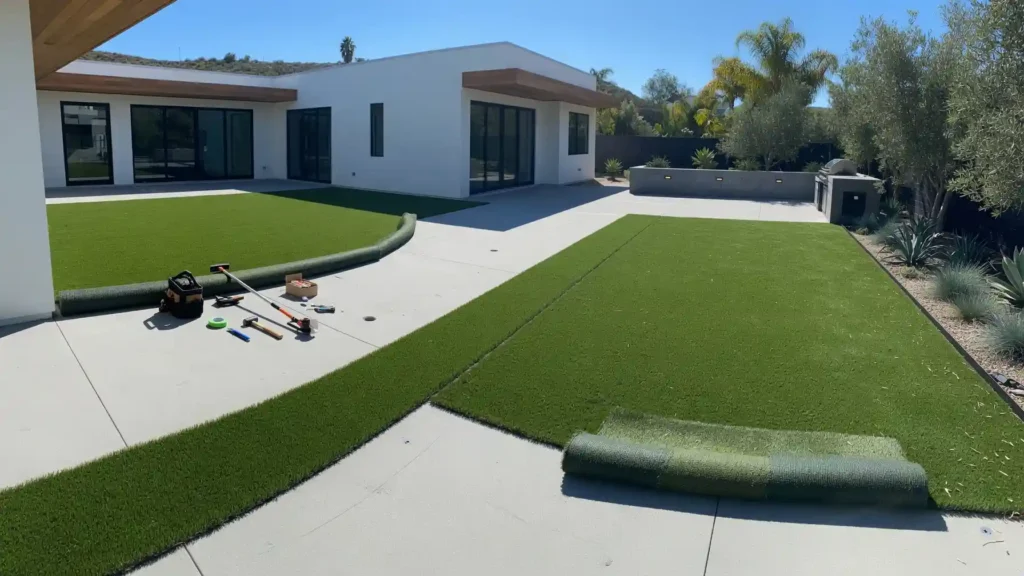
To install artificial grass on concrete, clean and repair the slab, give water a path out, lay the turf, glue the edges and seams, and brush in infill. The slab must be stable. Water must have somewhere to go.
This guide covers each step, from the pre-install checks to the final brushing. It also covers drainage, heat, cost, and when to hire a pro. Our crews install turf on San Diego County patios, pool decks, and rooftops. The steps below work in any climate.
Project Overview
Skill level | Moderate. Seams and glue are the hardest parts |
Time | 1 to 2 days for a small patio, plus glue cure time |
Biggest risk | Water trapped under the turf |
Can You Install Artificial Grass on Concrete?
Yes. Concrete is a firm, flat base. You skip the digging and base work that soil needs. That makes the job faster.
The trade-off is water. Concrete does not absorb it. Every install needs a plan for where the water goes. That plan is the main skill in this job.
A stable slab that sheds water is ready for turf. A slab that rocks, sinks, or holds puddles is not. Turf hides those flaws for a while. Then they show up as lifted seams and soggy spots.
Is Your Concrete Ready for Artificial Grass?
Run four checks before you buy anything. They take about 30 minutes. You need a garden hose, a tape measure, chalk, and a cup of water.
Check 1: Walk the Slab
Walk the whole surface and step on every section. Look for cracks, holes, flaking spots, and crumbling edges. Feel for any section that rocks or sits higher than the next one.
A hairline crack that sits flat is fine. Fill any crack wider than 1/4 inch. A crack with one side higher than the other means the slab is moving. That movement will show through your turf.
Mark every expansion joint with chalk. These joints are built to move. Plan your seams around them.
Check 2: Run the Hose Test
Soak the slab for five minutes. Then watch where the water goes. It should flow toward a drain, lawn, or garden bed. A slight slope away from the house is good. About 1/8 to 1/4 inch per foot works well.
Circle any spot where water still sits after 20 minutes. Turf does not fix a low spot. It hides it, and trapped water leads to odor and mold. The drainage section below covers the fixes.
Check 3: Measure Every Edge
Turf, glue, and any pad add height. Measure the drop from the slab to the bottom of each door sill, gate, and step. Plan on at least 2 inches.
Less than that can block a door, push water toward the house, or create a trip edge.
Also check these spots. Each one changes how you cut and secure the turf:
- Pavers and walls
- Pool edges
- Drain covers
- Posts
- Garden borders
Look at stucco walls too. They have a metal weep screed at the base that must stay clear of the finished surface. Turf raises that surface. Ask your city for the exact clearance.
Check 4: Test for Sealer, Paint, and Grease
Sprinkle water on a few bare spots. If it beads up, the slab has a sealer or coating. If it soaks in within a minute, the concrete is bare.
Glue cannot hold on sealer, paint, or oil. Grind coated concrete down to bare concrete. Scrub oil stains with a degreaser.
Pass or Fix: Quick Guide
What You Check | Pass | Fix First |
Cracks | Hairline cracks that sit flat and flush | One side is higher, or the slab rocks or sinks |
Drainage | Water clears within 20 minutes | Puddles remain after 20 minutes |
Surface | Solid, clean, and sound | Flaking, crumbling, or holes |
Expansion joints | Marked and planned around | Wide, uneven, or shifting joints |
Door and edge clearance | At least 2 inches of drop | Less than 2 inches at doors or gates |
Sealer or paint | Water soaks in | Water beads on the surface |
What to Do If Your Slab Fails
Fill small cracks and chips with concrete patching compound. Rocking sections, raised cracks, and deep dips mean the base under the slab has failed. Patching will not hold. Have a pro look at it and replace that section before you buy turf.
If your slab passes all four checks, move on to choosing your turf.
Tools and Materials You Need
Concrete jobs use glue instead of stakes and a gravel base. The list is shorter than a soil install.
Category | What You Need |
Cleaning | Broom, hose or pressure washer, concrete degreaser |
Repair | Concrete patching compound, self-leveling compound |
Measuring | Tape measure, chalk line, long level or straight board |
Cutting | Utility knife with sharp hooked blades |
Bonding | Polyurethane turf adhesive, seam tape, notched trowel |
Underlay | Foam shock pad or drainage mat, if needed |
Finishing | Stiff push broom, silica sand infill, roller or weights |
Safety | Gloves, knee pads, eye protection |
Use a polyurethane adhesive made for turf. MAPEI notes that one-part turf adhesives cure slower in cold or dry air, while two-part products cure fast and predictably in harsh conditions. Read MAPEI’s turf adhesive guide and your turf maker’s rules before you buy.
Do not use indoor carpet glue or general construction adhesive. They break down outdoors. Double-sided turf tape works for light use, such as a rental patio.
How to Choose Artificial Grass for Concrete
Match the turf to how you will use the space.
- Use: A decorative patio needs a good look and a soft feel. A pet area needs easy cleaning. A play area needs a safe surface system (see the next section).
- Pile height: Shorter pile leaves more room at doors. The taller pile feels softer.
- Density and backing: Choose dense turf for heavy traffic. Pick a perforated backing so water passes through.
- Warranty: Read what it covers, including sun fade and wear.
- Maker rules: Check the install guide for the turf, glue, tape, and pad you buy. Glues are not interchangeable.
Do You Need Underlay, a Shock Pad, or a Drainage Mat?
These are three different products.
- Shock pad or foam underlay: Adds cushion, hides small flaws, and adds height. Use it for kids, pets, seating areas, and spots where people stand a lot.
- Drainage mat: A raised layer that gives water a channel under the turf. Use it on a flat slab or where water drains slowly.
- Nothing: A sloped slab with perforated turf and no cushion needs neither.
Do not treat a foam pad as fall protection. The Consumer Product Safety Commission lists concrete, and carpet not tested to ASTM F1292, as inappropriate playground surfaces. If kids will use play equipment, read the CPSC Public Playground Safety Handbook. Buy a surface system with ASTM F1292 test data for your fall height.
How to Prepare Concrete Before Installing Artificial Grass
Work in this order.
- Clean. Sweep the slab. Wash off dirt, leaves, and moss with a hose or pressure washer.
- Degrease. Scrub oil and grease with an outdoor concrete degreaser. Rinse well.
- Remove coatings. Grind off any sealer or paint that failed the water test.
- Repair. Fill cracks wider than 1/4 inch and patch chips and holes. Let the patch cure fully.
- Level. Lay a long straight board across the slab. Fill dips with self-leveling compound. Small bumps show through turf.
- Dry. Let the slab dry fully before you glue. Tape a clear plastic sheet to the slab for a few hours. Fog under the plastic means the slab is still damp.
How to Measure and Plan the Installation
Measure twice. Mistakes at this stage are the expensive ones.
- Area: Multiply length by width. Break odd shapes into rectangles and add them up.
- Extra turf: Buy 10 to 15 percent more than your total. Use the higher number for curves and many cuts.
- Grain: Turf has a grain like carpet. Lay every piece with the blades leaning the same way. The mixed direction looks like two colors.
- Seams: Plan them before you cut. Keep them out of main walking paths and off expansion joints.
- Obstacles: Mark posts, drains, and planters with chalk.
How to Install Artificial Grass on Concrete: Step by Step
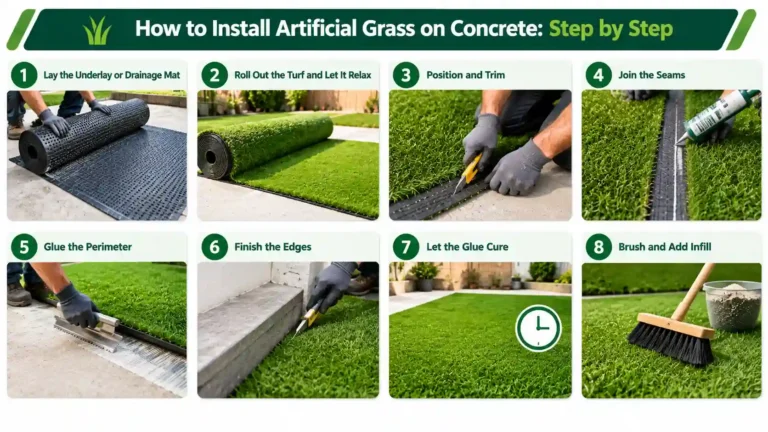
Your slab is clean, repaired, and dry. Follow these eight steps in order.
Step 1: Lay the underlay or drainage mat.
Roll it out and cut it to fit. Tape the seams so nothing shifts. Follow the maker’s glue rules. Leave openings at drains.
Step 2: Roll out the turf and let it relax.
Unroll the turf in place without gluing. Leave it in the sun for at least two hours. This removes roll creases and helps prevent wrinkles.
Step 3: Position and trim.
Check that all blades lean the same way. Cut from the back along a stitch row. Leave about 1 inch extra at the edges. Trim to final size later.
Step 4: Join the seams.
Fold both edges back. Center seam tape under the joint. Spread adhesive on the tape. Press the edges together, keeping fibers out of the glue. Weigh the seam down while it sets.
Step 5: Glue the perimeter.
Fold the turf back. Spread a band of adhesive about 6 inches wide along the edge with a notched trowel. Press the turf into the glue and smooth out air pockets. Leave the center unglued so water can move under the turf. If your turf maker calls for full glue-down, follow their rule.
Step 6: Finish the edges.
Trim the turf tight against walls and steps. Where turf meets soil or gravel, pin it to edging fixed in the soil.
Step 7: Let the glue cure.
Stay off the turf. Follow the label. Plan on a full day before regular use.
Step 8: Brush and add infill.
Brush the fibers upright with a stiff broom. If your turf calls for infill, spread silica sand evenly. Brush again to work it into the pile. Infill holds the blades up and adds weight.
How to Manage Drainage Under Artificial Grass on Concrete
Perforated backing lets water pass through the turf. It does not let water pass through the slab. The water must travel over the concrete to an edge or drain.
Three tools handle this.
- Slope: A slab that falls 1/8 to 1/4 inch per foot moves water on its own.
- Drainage mat: Adds a channel under the turf on flat slabs.
- Weep holes: Drill 5/8 inch holes through the slab at low spots and fill them with small gravel. Use this only on a slab poured on the ground.
Never drill a balcony, rooftop, or raised slab. You can break the waterproof layer and cause leaks below. Before you drill any slab, check for post-tension cables, pipes, and radiant heat lines. Cutting a cable is dangerous. If you are unsure, ask a pro.
Signs of a drainage problem are a musty smell and turf that stays damp after rain. Pet owners should also rinse the area and use a pet-safe enzyme cleaner. Read How Does Artificial Turf Drain Water? for more.
How to Manage Heat on Concrete-Based Turf
Turf gets hot in direct sun. In Penn State lab tests, every infilled turf system passed 150°F, and outdoor results were similar. The full study is on the Penn State Center for Sports Surface Research site. Concrete stores heat, so the surface can stay warm into the evening.
This matters in San Diego and across the Sun Belt. These steps help:
- Add shade. A pergola, sail, or umbrella cuts heat more than any product.
- Pick lighter fibers and cooling infill. In the Penn State tests, fiber and infill choices changed temperatures by 12 degrees or less. Treat them as a small help.
- Rinse with a hose. It cools the surface, but only for a short time.
- Use the hand test. Press your palm on the turf for 10 seconds before kids or pets step on it.
Common Installation Mistakes and Fixes
Problem | Likely Cause | Fix |
Wrinkles or bubbles | Turf was not relaxed, or air is trapped under it | Lift the section, warm it in the sun, and re-glue it flat |
Lifting edges | Glue went on a dirty, damp, or sealed slab | Clean and dry the slab, then apply fresh adhesive |
Visible seams | Blades lean different ways, or tape is off center | Pull the seam apart and redo it |
Gaps after cutting | Turf was cut before it relaxed | Re-lay the piece, or replace the section |
Water pooling | No slope or drainage path | Add weep holes on a ground slab, or add a drainage mat |
Sliding turf | Glue band too narrow, or infill missing | Widen the glued band and add infill as the turf calls for |
Odor | Trapped moisture or pet urine | Flush with enzyme cleaner and clear blocked drainage |
Glue fails in a season | Wrong adhesive | Re-glue with a polyurethane turf adhesive |
How to Maintain Artificial Grass on Concrete
Rinse the turf every few weeks to clear dust and pollen. Brush against the grain every month or two to lift the fibers. Check the seams and perimeter twice a year for lifting. Remove pet waste right away and rinse the spot. Check that drains and weep holes stay clear.
Where Can You Install Artificial Grass Over Concrete?
- Patios and courtyards: The easiest and most common jobs.
- Pool decks: Keep turf clear of skimmer lids and drain covers.
- Balconies and rooftops: Check the load limit, the waterproof layer, and building rules first. Do not drill. Water must reach an existing drain.
- Dog runs: Plan drainage and odor control first.
- Play areas: Follow the fall-protection rules above.
Keep grills, fire pits, and hot embers away from turf. Sun reflected off windows can also melt fibers.
DIY vs. Professional Installation
DIY saves labor cost. It fits a small slab in good shape and a homeowner who is comfortable with glue and a utility knife.
Hire a pro for large areas, rooftops, pool surrounds, and slabs with drainage problems. Seams and glue are the hardest parts to fix once they set.
How Much Does It Cost to Install Artificial Grass on Concrete?
Cost guides put installed turf on hard surfaces at roughly $6 to $25 per square foot. One guide lists patios and gazebos at $15 to $20 per square foot, and roof decks and balconies at $15 to $25. An older guide gives a lower range of $6 to $15 for turf over a hard surface, with materials and labor included.
Item | Typical range |
Turf material only | $2 to $7 per sq ft |
Installed on a patio | $15 to $20 per sq ft |
Installed on a roof deck or balcony | $15 to $25 per sq ft |
Small jobs cost more per square foot. One 2026 guide puts projects under 400 square feet at $17 to $25 per square foot. Crew setup time stays the same on a small job, so the cost is spread over fewer square feet.
Here is a simple example. A 300 square foot patio at $15 to $20 per square foot totals about $4,500 to $6,000.
For comparison, San Diego lawn installs run $12 to $20 per square foot in 2026 guides. Lawn jobs include digging and a gravel base. Concrete jobs skip that work. They add slab repair, drainage, and glue work instead.
Your price goes up with:
- Slab repair, grinding, and leveling
- Drilling or a drainage mat
- Underlay or shock pad
- Higher turf grade or pile height
- Hard access, such as stairs or a rooftop
DIY costs less. Turf alone runs about $2 to $7 per square foot. Add adhesive, seam tape, a pad if you need one, and tools.
These are national estimates, not quotes. Prices change by year and by city. Get two or three written quotes for your slab. Read How Much Does It Cost to Install Artificial Turf? for lawn pricing.
Professional Artificial Grass Installation in San Diego
SD Home Turf installs artificial turf in San Diego and nearby Southern California communities. We work on concrete patios, rooftops, and pool decks. Our crews handle slab prep, drainage, and installation, so you do not have to guess at any step. If you are outside our area, ask your turf maker for a certified installer.
Ready to turn your concrete patio, balcony, or rooftop into usable space? Call SD Home Turf today for a free estimate.
Frequently Asked Questions
Can you install artificial grass on concrete without glue?
Yes, for small or temporary spaces. Use double-sided turf tape or interlocking turf tiles. Weights alone will not hold turf in the wind.
Do I need to drill holes in the concrete?
Only if the hose test shows standing water on a slab poured on the ground. Never drill a balcony, rooftop, or raised slab.
Can I install artificial grass on painted or sealed concrete?
Not until you grind the coating off. Glue cannot bond to sealer or paint.
What if my slab has cracks?
Fill cracks wider than 1/4 inch with patching compound. Hairline cracks that sit flat can stay. A crack with one side raised means the slab is moving and needs repair first.
What is the best adhesive for artificial grass on concrete?
Use a polyurethane adhesive made for turf. It holds up outdoors. Match it to your turf and the weather, and follow the label.
How long does artificial grass last on concrete?
Many quality turfs are built to last 15 years or more. Drainage, sun, and traffic decide the real number. See How Long Does Artificial Turf Last?.
Does artificial grass on concrete get hot?
Yes. Turf gets very hot in direct sun, and concrete holds heat. Shade helps most.
Can artificial grass be removed from concrete later?
Yes. Glue leaves residue, and removal takes scraping and cleanup. Renters should use tape or loose-lay tiles.