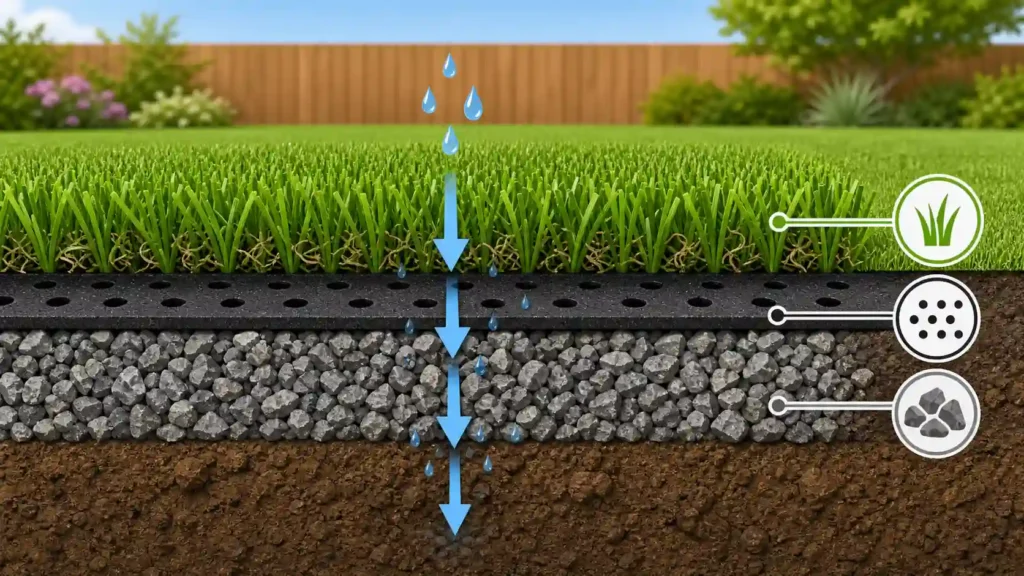
How does artificial turf drain water? It moves down through small holes in the turf backing, into a layer of crushed rock underneath, and then into the soil below it. Artificial turf does not soak up water the way real grass does.
This system works well in most yards. But it only works as well as the base, the slope, and the soil under it. We will walk through each part below.
How Water Moves Through Artificial Turf
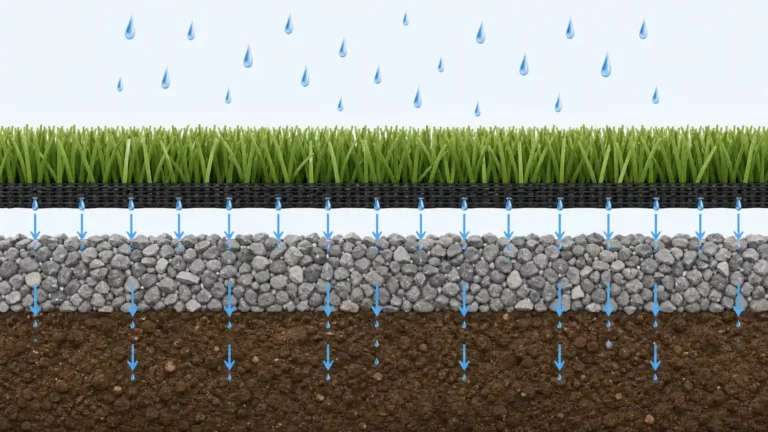
Artificial turf is built to let water move through it rather than hold water on the surface. The drainage process has three main stages: the turf backing, the base and the soil.
Understanding these stages makes it easier to see why some artificial lawns drain well while others develop standing water.
Water Passes Through the Turf Backing
Turf fibers are plastic. They don’t need to absorb water the way a natural grass blade does. Water simply moves down and around the fibers toward the backing underneath.
Most artificial turf drainage systems use one of two backing types. A perforated backing has small drilled holes spaced evenly across the surface. A fully permeable backing lets water pass through the entire material, not just through holes.
Both types are built to move water fast. The Synthetic Turf Council’s own performance guidelines call for a water permeability rate above 10 inches per hour after installation, based on ASTM F1551 testing. That is far more water than a normal storm will ever drop on your yard at once.
Water Moves Into the Base
Once water clears the backing, it reaches the base underneath. This layer is usually made of crushed rock, decomposed granite, or another aggregate material.
A good base is compacted enough to hold the turf’s shape, but it still has small gaps between the rock particles. Those gaps are what let water keep moving down instead of pooling right under the turf. This is also why the sub-base for artificial grass matters so much. A base that’s too fine, too thin, or packed too tight will slow water down no matter how good the turf on top is.
Water Continues Into the Soil
This is the part most people never think about, and it’s where real drainage problems usually start.
Water doesn’t stop at the base. It has to keep moving into the soil underneath the whole system. If the soil accepts water well, like sandy or loose soil, water keeps draining down and away.
If the soil is poor-draining, like heavy clay, water moves much slower. Clay soils can have an infiltration rate below one tenth of an inch per hour, compared to several inches per hour for sandy soil, according to USDA soil infiltration data. When that happens, water can sit and saturate the ground under your base, even if the turf and base did their job correctly.
This is why proper grading matters before installation, not after. Our guide on how to prepare the ground for artificial grass covers how we check and adjust for soil conditions before any turf goes down.
Does Artificial Turf Drain Well Compared to Regular Grass?
Artificial turf and natural grass handle water in different ways.
Natural grass depends heavily on the soil beneath it. Rain reaches the grass and then moves into the soil. How quickly that happens depends on the soil type, its condition and how much water it can accept.
Artificial turf creates a more defined drainage pathway. Water can move through the turf backing and into the prepared base before reaching the soil.
That gives artificial turf a key advantage in the turf layer itself. The surface does not depend on grass roots or soil at the surface to absorb water.
But that does not mean artificial turf is independent of the ground below it.
The soil still matters.
A yard with permeable soil may allow water to move away quickly. A yard with poor-draining soil may hold water beneath the turf for longer.
So, is artificial turf drainage comparable to a regular lawn?
It can be very effective, but the two systems should not be judged in exactly the same way. Natural grass relies more directly on soil infiltration. Artificial turf uses a designed pathway through the backing and base before water reaches the soil.
The complete drainage system is what determines the result.
What Happens When It Rains or You Irrigate Artificial Turf?
Rainwater follows the same basic drainage path.
Rain lands on the turf surface, moves between the turf fibers and travels downward through the permeable backing and drainage holes. It then enters the base and continues toward the soil or another intended drainage path.
Light rain may move through the system quickly. Heavy rainfall can place much more water on the area in a short period.
Irrigation works in much the same way.
When you water an artificial lawn, the water does not need to be absorbed by the turf blades. It moves through the surface and follows the drainage pathway underneath.
This is why a properly installed artificial lawn should not behave like a waterproof sheet during normal rain or irrigation.
If water remains on the surface after normal watering, the important question is what is stopping that water from moving away.
The issue may involve the slope, the drainage pathway, the base or the soil below it.
How Slopes Affect Artificial Turf Drainage
Slope helps control where water goes across the surface.
The backing and drainage holes help water move through the turf. The slope helps water move across the site toward its intended direction.
These are different jobs.
Think of the drainage process this way:
- Backing: let water move through the turf.
- Drainage holes: provide openings for downward flow.
- Base: provides a path beneath the turf.
- Slope: helps direct surface water.
- Soil: receives water after it moves through the system.
A properly graded area gives water a direction to follow instead of allowing it to collect in a low spot.
This matters most where the ground already has a natural slope or where the site needs grading before installation.
Drainage should be considered as part of the complete artificial grass installation, not as a feature of the turf roll alone.
Can Poor-Draining Soil Cause Standing Water Under Artificial Turf?
Yes.
This is one of the most important facts about artificial turf drainage.
Even when water passes correctly through the turf backing, the soil below can still slow the final stage of drainage.
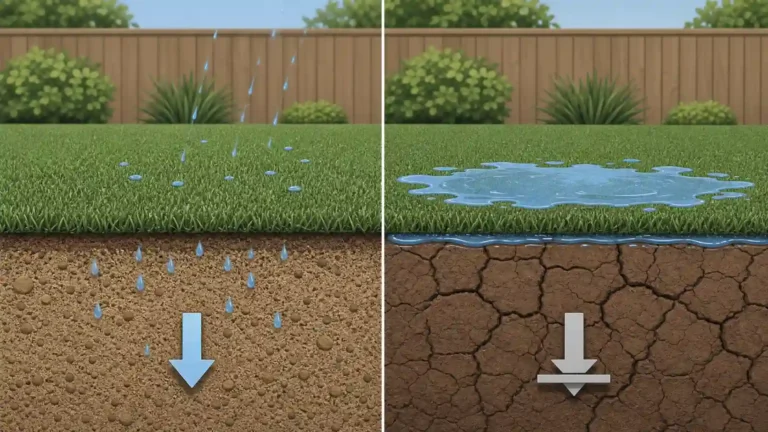
Poor-draining soil may have low permeability. Some soils accept water slowly, while saturated soil may accept very little additional water until existing moisture moves away.
Clay-heavy ground is one example of soil that can restrict water movement.
This creates two different standing-water situations.
Water standing on top of the turf
Water remaining on the turf surface can point to a problem with the surface flow or the path available for water to leave the area.
Slope and grading matter here.
Water remaining beneath the turf
Water below the turf points to a different part of the drainage pathway.
The base and underlying soil determine how easily water can move away after passing through the backing.
This distinction matters because artificial turf itself may not be the cause.
A permeable turf product cannot force poorly draining soil to absorb water faster.
That is why site conditions should be considered before installation. The turf, backing, base, slope and soil need to work as one drainage system.
When Does Artificial Turf Have Drainage Problems?
Good drainage isn’t one thing working. It’s five things working together: permeable backing, open drainage holes, a properly built base, soil that can accept water, and a slope that matches the site.
Artificial turf drainage problems almost always trace back to one of these parts being restricted, not to the turf material failing on its own. In our experience, the most common causes we see during inspections are:
- A base that wasn’t compacted correctly during installation
- Base material with too much fine dust or sand mixed in, which blocks water flow
- Not enough slope built into a flat yard
- Skipping a soil check before installation on a lot with heavy clay
Most of these trace directly back to how the job was done at install time. Our article on common artificial grass installation mistakes covers these in more detail, including how each one shows up later as a drainage complaint
Why Proper Installation Is the Real Drainage System
Here’s the point worth repeating. Most drainage problems trace back to how the artificial grass installation was handled, not to a bad batch of turf.
A good installer checks the soil, builds the base to the right depth, compacts it properly, and grades the yard before turf ever gets laid down. Skip any one of those steps, and you’re rolling the dice on standing water down the road.
At SD Home Turf, we treat drainage as part of the install, not an extra add-on. If you’re comparing artificial turf installation services in San Diego County, ask any installer how they test soil and grade for water flow before they quote you a price. That answer tells you more about the long-term result than the turf sample they hand you.
Ready to get it done right the first time? Contact SD Home Turf for a free on-site consultation, and we’ll walk your yard’s soil, slope, and drainage needs with you before you commit to anything.
Conclusion
Artificial turf drains water by letting rain and irrigation pass through its backing and into a prepared base. From there, water has to move through the soil or follow the yard’s slope toward a drain point. The turf itself can drain fast, but poor soil, a bad slope, or a blocked base can still lead to standing water.
So if someone asks you how artificial turf drains water, the real answer is: through the turf, through the base, and finally through the ground underneath it. Every stage matters.
FAQs
Does artificial turf drain well in heavy rain?
Yes, when the backing, base, and slope are all built correctly. Most turf systems can move water through fast, but they can’t make up for bad soil or a flat yard with no grading.
Do I need a special drainage system under artificial turf?
Most yards just need a properly built base and correct grading. Lots with heavy clay soil sometimes need added drainage measures, like a French drain, worked into the installation plan.
What causes most artificial turf drainage problems?
The most common causes are a poorly compacted base, base material mixed with too much fine dust or sand, not enough slope, and soil that doesn’t accept water well.