
Here is how to install artificial grass between pavers. Measure each gap, plan for drainage, build a firm base, cut the turf strips to fit, and secure them. Then finish each strip level with the pavers.
Paver gaps are narrow, so turf strips need tighter fitting than an open lawn. A small error in width, base or securing shows right away. Artificial turf and pavers installation goes best when you take it one step at a time.
Measure Each Space Between the Pavers
Start with a measuring tape and a notepad. Measure each paver gap on its own. Gaps that look equal often are not.
Check the width at several points along every gap. Write down the smallest and largest numbers. An irregular gap needs a strip cut to its widest point, then trimmed in place.
Measure the length too, and note every curve and angled corner. Curves need extra material, so you can trace the shape before the final cut.
Mark which way the blade direction runs, and keep it the same on every turf strip. Mixed directions show up as dark and light patches. Allow about one inch of extra turf on each edge for final trimming. Buy more turf than your total, because off-cuts rarely fit other gaps once the blade direction is set.
Prepare and Level the Base Between the Pavers
Clear each gap first. Remove loose material, debris and weeds. Then look at what is underneath. It may be soil, old base material or a concrete slab.
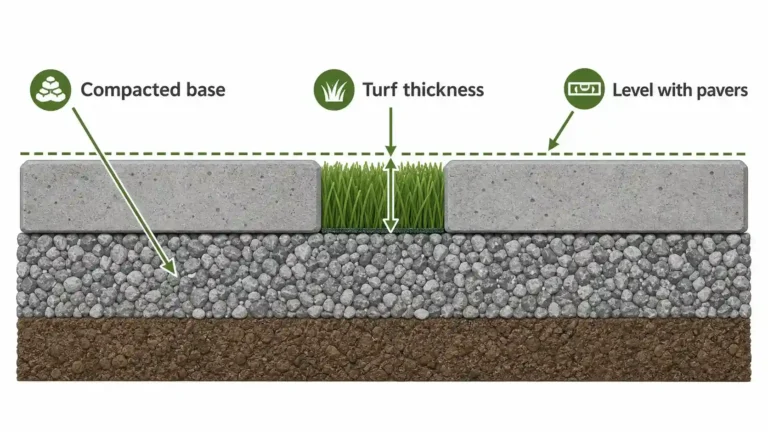
Soil needs a sub-base made of compactable aggregate, such as Class II road base or decomposed granite. Many manufacturer guides call for 2 to 3 inches of base material. The same base rules apply to a full lawn, and our artificial grass installation guide covers them in more detail.
Narrow gaps make compaction hard, because a plate compactor will not fit. Use a hand tamper and work in thin layers. Lightly wet the base so it packs tighter. Tamp until the surface feels firm and does not shift under your boot.
Leveling decides how the finished job looks. Set the base lower than the paver surface by the thickness of the turf. That way the finished elevation matches the pavers. Lay a straightedge across the pavers and measure down to the base in several spots. Scrape off high spots, then fill low spots and tamp again.
A concrete slab needs no base. Clean it and check that it is flat.
Check Drainage Before Laying the Turf
Water must be able to leave the gap. Spray the prepared base with a hose and watch the water flow for a minute. Low spots show up as puddles.
Fix them now by adding base material to each low spot and tamping it down. A permeable base lets water pass through instead of sitting on top. Keep the existing grade, so water still runs away from the house. Pavers with artificial grass in between still need a clear path for water to escape.
On a concrete slab, water has nowhere to go. Drill small drainage holes where it pools, or grade the surface. For more detail, read about how artificial turf drains water.
Measure and Cut the Artificial Grass to Fit
Unroll the turf and let it rest in the sun for one to two hours. This relaxes the backing and removes folds. Then lay a strip along its gap to test the fit.
Flip the turf over and mark your cut line on the turf backing with a marker. The backing shows rows of stitching. Cut between the rows, never across them. Cutting through stitching lets blades fall out later.
Use a sharp utility knife and change the blade often. Cut from the backing side, so you do not slice the fibers. Make several light passes instead of one deep cut. A single hard cut tends to drift off the line.
Leave a small amount extra and trim in place later. Set each cut strip in its gap. Check that the turf blade direction matches the strips beside it. A strip that is too wide buckles. One that is too narrow leaves a visible gap at the paver.
Secure Turf Between Pavers

Position the strip and press it flat first. Then pick the fastener that suits the surface below.
Over soil or a compacted base, use turf nails or staples. Many manufacturer installation guides list nails every 3 to 4 inches along the edges. Check your own turf guide for nail length and spacing. Pull the strip lightly, because hard pulling lifts the sides.
Part the blades before each nail. Tap the nail in until the head sits on the backing. Then smooth the blades back over it. Never drive nails too deep, since that leaves a dip. Where two strips meet, join them with seam tape and turf adhesive.
Over concrete or another hard surface, nails will not hold. Use turf adhesive made for artificial turf instead. Apply it to a clean, dry surface, following the label. Press the turf down and weigh the edges until the adhesive cures.
Artificial turf with pavers holds best when both edges of each strip are fixed. Pavers with grass between them see foot traffic, and loose edges soon curl. Check that no fastener shows.
Finish the Edges and Check the Level
Trim the final edge with a utility knife, cutting along the paver edge. Keep the turf edge tight against the paver, with no backing showing. Tuck stray fibers into the gap with a flat tool.
Check the pavers themselves too, because they must not move. The Interlocking Concrete Pavement Institute calls edge restraints an essential part of a paver system. Loose pavers shift and pinch the turf.
Now test flatness by running your hand over every strip to find buckles or raised spots. Lay a level or straightedge across the turf and the pavers. The transition should feel smooth, with no lip.
Verify the finished elevation at several points. If a strip sits high, lift it, scrape the base and set it again. Fix every uneven transition before you add infill.
Add Infill and Brush the Turf
This is the finishing step. Add infill only if your turf system calls for it. Silica sand is a common choice. Many guides suggest 1 to 2 pounds per square foot.
Spread it by hand or with a small scoop, since a spreader will not fit narrow strips. Work the infill down between the blades. Then brush with a stiff-bristle broom, both with and against the grain, to lift the turf fibers.
Check the edges again after brushing. The blades should stand up, and no nail head should show. Finish with a slow walk along every strip, looking for gaps, lifted edges and puddles.
Conclusion
Knowing how to install artificial grass between pavers comes down to careful measuring, a firm base and clean edges. Take each strip one at a time. A tidy finish is worth the extra minutes.
If your project also includes new hardscaping, SD Home Turf can handle both. See our hardscaping services in San Diego County or request artificial turf installation for a free estimate.
FAQs
Should I set the pavers before laying the turf?
Yes, set and lock the pavers first so the gaps stay fixed. If you still need them, start with concrete paver installation. Then cut the turf to the finished gaps.
Can I use one wide piece instead of strips?
Strips fit narrow gaps best. A wide gap may need two strips. Join them with seam tape and adhesive, and keep the blade direction the same.
Do I need a weed barrier?
Over soil, a weed barrier helps stop weeds from pushing up through the turf. Follow your turf maker’s guide for placement. A concrete slab does not need one.
What tools do I need?
You need a measuring tape, a marker, a utility knife, a hand tamper and a hammer. Add turf nails and a stiff-bristle broom. Bring turf adhesive if you are working over concrete.