Choosing an artificial turf installer is about more than finding a low quote. The right contractor should show proven experience, explain the installation plan, prepare a stable base, solve drainage issues, use quality materials, and stand behind the finished work.
Before you sign an agreement, compare each installer on the same core points. Look at their credentials, past projects, seams, written estimate, materials, and warranty. This makes it much easier to spot the difference between a skilled installation crew and a company that mainly sells turf. This guide walks through the 11 things that actually separate a solid job from a costly mistake.
1. Look for Proven Artificial Turf Installation Experience
Start with the installer’s actual experience, not just the number of years listed on a website.
Ask how long the company has performed artificial grass installation and how many similar projects it has completed. Experience with a small residential lawn is useful, but a large yard, sloped property, commercial area, or complex drainage site may require different skills.
Ask to see completed projects that are close to yours in size and site conditions. A good artificial turf installer should be able to explain why a certain base, drainage plan, turf product, or installation method was used.
You should also learn who will perform the work. A salesperson may know the products well, while the installation crew handles the actual site work. Ask about the crew’s practical experience with excavation, subgrade work, compaction, grading, seams, edge restraint, and infill.
Strong evidence of experience includes:
- A consistent project portfolio
- Completed residential and commercial projects
- References from similar jobs
- Clear knowledge of site conditions
- Specific answers about installation decisions
- Photos showing finished workmanship
The goal is not to hire the company with the biggest number. It is to find a synthetic turf contractor who can show relevant work and explain the decisions behind it.
2. Verify Licensing and Insurance Before Hiring
Do not rely on a website statement that says a contractor is “licensed and insured.” Verify it.
For a California project, the Contractors State License Board provides a public license search where homeowners can check a contractor’s license status and other available information.
You should also ask for proof of general liability insurance and workers’ compensation insurance. The CSLB advises consumers to request a Certificate of Insurance or verify coverage with the contractor’s insurance carrier. California employers generally must carry workers’ compensation insurance for employees, subject to the rules and exemptions that apply to their situation.
Check that the documents belong to the same company that will perform your project.
Also ask about any certification the installer claims to hold. Certified synthetic turf contractors can be useful when the certification is relevant and verifiable. Do not treat a badge or logo alone as proof of installation skill.
3. Ask the Installer to Explain the Installation Process
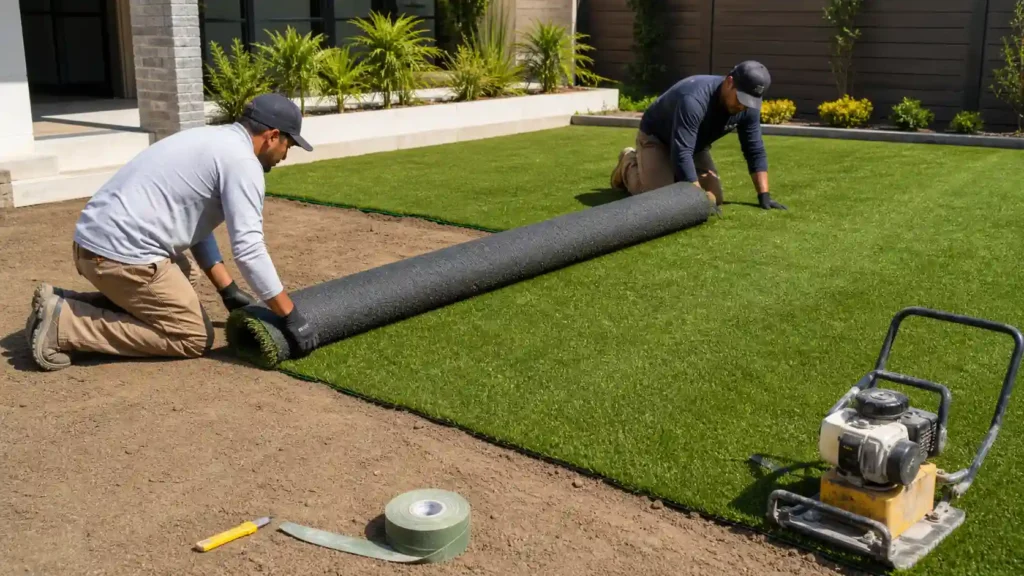
A professional should be able to explain the full artificial turf installation process for your property.
The plan should address the site assessment, removal of existing material, excavation, subgrade preparation, base installation, compaction, grading, drainage planning, turf placement, cutting, seaming, edge securing, infill, and final inspection.
The important part is not hearing a long list of steps. It is hearing a plan that fits your property.
For example, a good installer should be able to explain what happens if the existing soil is soft, where rainwater currently flows, how the finished grade will be set, and how the turf will be secured around the edges.
A vague answer such as “we prepare the ground and install the turf” does not tell you enough.
For a deeper look at the full process, see our guide on how artificial grass is installed.
4. Examine How the Installer Prepares the Base
The base is hidden after installation, but it has a major effect on the finished surface.
Ask:
“What base system will you use for my property, and how will you prepare and compact it?”
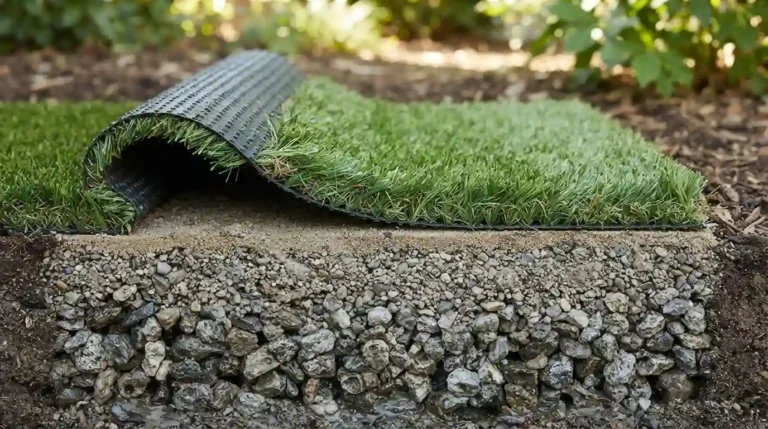
A proper plan should consider the existing soil or subgrade, excavation depth, base material, base thickness, layering, compaction, and final surface preparation.
Common materials may include aggregate, crushed rock, Class II road base, or decomposed granite, depending on the site and installation design. The correct choice depends on soil conditions, drainage needs, use, and local installation requirements.
Do not accept a quote that simply says “base included.” Ask what material will be used and how it will be compacted.
Poor soil stability or weak compaction can affect the finished surface. A detailed installer should be able to explain the proposed base rather than treating every yard the same.
Our guide on sub-base for artificial grass explains this part of the installation in more detail.
5. Evaluate the Installer's Drainage Plan
Drainage deserves a direct conversation before work begins.
Ask where water currently goes and what will happen after the artificial turf is installed. The installer should consider existing drainage conditions, site grading, water flow, low spots, soil drainage, the aggregate base, and the turf backing.
A permeable backing can allow water to pass through the turf, but the whole installation still needs a suitable path for that water.
For example, if a yard already has poor-draining soil or a low area, simply laying turf over it does not solve the underlying problem. The installer should explain how the finished grade and base will help move water away from the surface.
Ask a simple question:
“Where will the water go after it passes through the turf?”
A clear answer is more useful than a promise that the turf “drains well.”
Read our guide on how artificial turf drains water for more detail on this part of the installation.
6. Compare Turf Products and Material Quality
Do not choose an installer based only on the turf’s color or price.
Ask which turf manufacturer and product they recommend. Then ask why that product fits your property.
A useful product discussion may include turf fibers, yarn construction, blade shape, backing, UV resistance, drainage characteristics, intended application, and infill compatibility.
The installer should also provide product documentation when appropriate. This helps you understand what you are actually buying.
A premium artificial turf installation should not simply mean buying the most expensive turf. The product should match the way the area will be used.
For example, a decorative lawn may have different needs from a high-traffic residential area. A professional should explain that difference instead of pushing one product to every customer.
Also ask who provides the product warranty. The turf manufacturer may cover the material, while the installer covers workmanship.
7. Inspect the Quality of the Turf Seams
Seams deserve close attention because they can affect how natural the finished lawn looks.
When reviewing an installer’s portfolio, look closely at where two turf sections meet.
Check for:
- Straight seam alignment
- Consistent turf grain direction
- Low seam visibility
- Proper seam tape
- Suitable turf adhesive
- Clean joining
- No obvious wrinkles or gaps
- Consistent appearance across turf sections
Ask the installer how seams are joined and whether you can see completed projects in person.
A poor seam can remain visible even when the turf itself is high quality. That makes seam workmanship an important part of choosing an installer.
8. Read Reviews and Check Real Customer References
Reviews can tell you how a company performs after the sale.
Do not look only at the star rating. Read the details.
Look for repeated comments about installation quality, communication, professionalism, finished appearance, drainage, durability, and how the company handled problems.
Real customer references can provide even more useful information. If an installer provides references, ask about the quality of the finished work, reliability, communication, and whether the completed project matched the original agreement.
One detailed review from a similar project can be more useful than many short comments that only say “great service.”
The same rule applies to testimonials. Look for evidence that customers are discussing the actual installation experience.
9. Review the Installer's Project Portfolio
A strong portfolio should show more than attractive turf.
Look for projects similar to yours. Pay attention to clean edges, turf orientation, seam quality, transitions, surface finish, and overall workmanship.
Look for different site conditions too. A portfolio with only perfect, flat lawns tells you less than one showing varied residential or commercial installations.
If possible, ask when the project was completed. Older projects can help you judge whether the installer has a history of producing consistent results.
The goal is to judge the installation, not just the turf.
Anyone can photograph a new green lawn. A good artificial turf portfolio shows how well the contractor handles the details that remain visible after installation.
10. Get a Detailed Written Estimate
Do not compare quotes by price alone.
A written estimate should make it clear what each contractor is actually proposing.
Look for:
- Scope of work
- Turf product and specifications
- Material quality
- Base preparation
- Drainage work, if needed
- Seaming
- Infill
- Installation labor
- Warranty information
- Total project cost
This matters because two contractors can quote the same square footage while including very different work.
For example, one quote may include substantial excavation and base preparation, while another may use a much lighter preparation plan. The lower number does not automatically mean better value.
What does artificial turf cost in San Diego?
Current 2026 market estimates place professionally installed artificial turf in San Diego in a broad range of about $11 to $26 per square foot, with another current estimate placing many projects around $12 to $20 per square foot.
That means a 1,000-square-foot project could roughly fall around $12,000 to $20,000 in many cases, while more complex projects can run higher.
Treat these figures as market benchmarks, not a guaranteed price. Excavation, soil conditions, drainage work, base requirements, turf quality, access, seams, and project size can all change the final estimate.
A written proposal lets you compare those differences instead of choosing the lowest number on the page.
11. Compare Warranties Before You Sign
Do not assume every warranty covers the same thing.
There are usually two important types to understand.
Product or manufacturer warranty: This applies to the turf material and is provided by the turf manufacturer under its stated terms.
Installation or workmanship warranty: This applies to qualifying problems caused by the installation work and is provided by the installer under the terms of its agreement.
Ask about:
- Warranty length
- Covered problems
- Exclusions
- Who provides the warranty
- Whether labor is covered
- How claims are handled
- Whether the terms are provided in writing
An artificial grass installation warranty should be clear before you sign, not something you try to understand after a problem occurs.
How to Make the Final Decision
The strongest installer should be able to prove more than a low price.
Look for an artificial turf contractor who can show relevant experience, provide licensing and insurance documentation, explain the installation process, give you a clear base and drainage plan, recommend suitable turf products, produce clean seams, provide credible reviews and references, show comparable projects, give you a detailed written estimate, and explain the warranty in writing.
If the answers are vague, the estimate leaves out major work, or the company cannot show comparable projects, slow down before signing.
For homeowners considering artificial turf installation in San Diego County, SD Home Turf focuses on the details that affect the finished installation, from site preparation and base work to drainage, turf selection, and final workmanship.
Ready to compare your options? Contact SD Home Turf for a project consultation and a written estimate tailored to your property.