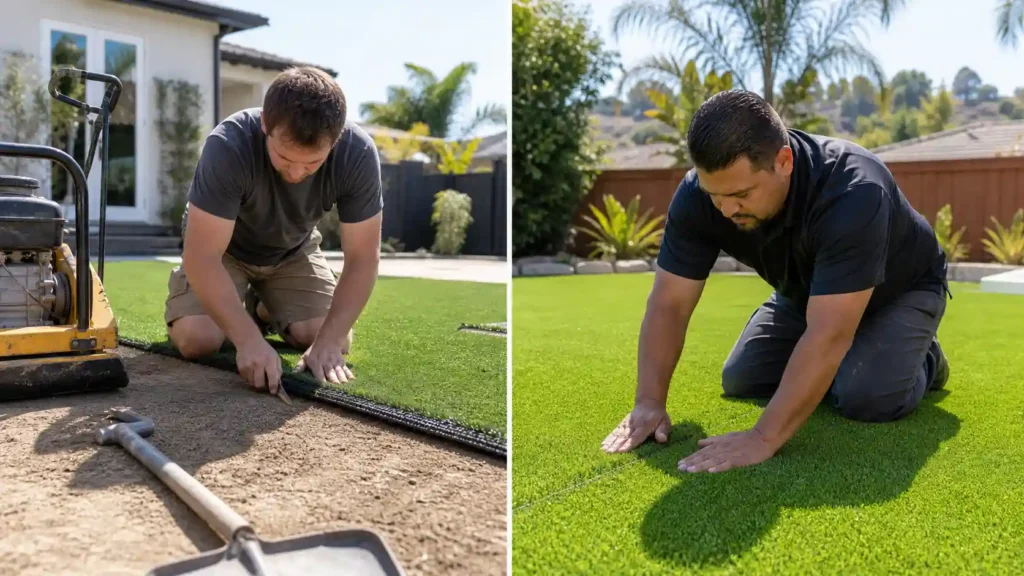
Yes, you can install artificial grass yourself, but not every yard is a good DIY project. A small, simple lawn can be manageable if you have the tools, time, and strength for excavation, base work, cutting, and securing the turf.
The real choice comes down to more than rolling out grass. Project size, site condition, drainage, seams, edge restraint, tool access, and the quality of the finished work all matter. A professional becomes more useful as those demands increase. This guide breaks down exactly where DIY gets hard, and where it pays to call in help.
Can You Install Artificial Grass Yourself? Quick Answer
DIY artificial grass sounds simple. Roll it out, cut it to fit, done. That is not how it actually works.
The turf itself is the easy part to handle. The real work happens before you ever touch the roll. Ground prep, base compaction, drainage, and seams are what separate a lawn that lasts fifteen years from one that fails in twelve months.
DIY synthetic grass installation is realistic when your project is small, your site is flat, and you are ready for real physical labor. For most residential lawn installation projects, site conditions matter more than skill level. You need basic tools, patience for precise cutting, and a willingness to get the base right before the turf goes down.
Professional installation makes more sense as the yard gets bigger, the drainage gets trickier, or the layout gets more complicated. Complexity adds up fast on an installation project, and mistakes made early are hard to fix once the turf is already down.
How Difficult Is DIY Artificial Turf Installation, Task by Task?
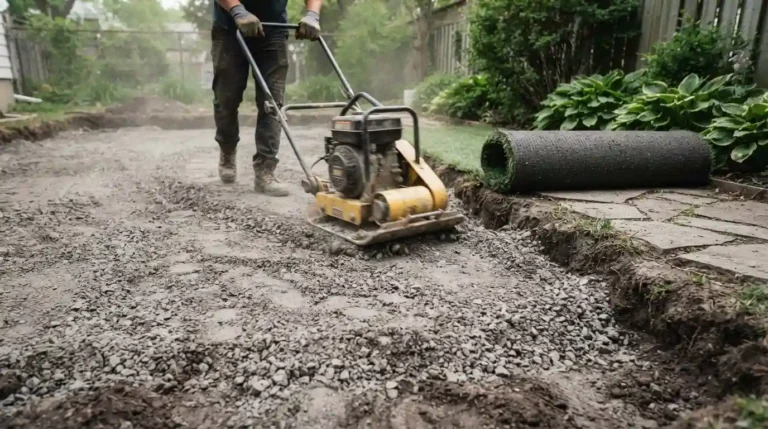
DIY artificial turf installation involves three kinds of work: physical labor, precise detail work, and problem solving when the site is not perfectly flat or square. Here is where each task actually gets hard, and why a simple-looking step can turn into a technical one.
Excavation
Digging out the old lawn looks straightforward. In practice, you are removing soil, roots, and debris across the whole area, often three to four inches deep. The work becomes physically demanding fast, especially in clay soil or a sloped yard. Get the depth wrong and your finished turf sits too high or too low against patios and walkways. For the full process, see how to prepare the ground for artificial grass.
Base Compaction
Spreading base material looks simple. Compacting it correctly is not. You need even layers of aggregate, packed down with a plate compactor, not just a rake and your body weight. Skip a pass or rush the compaction, and the ground settles unevenly months later, leaving dips and low spots under your turf. Learn more in the sub-base for artificial grass.
Turf Cutting
Cutting turf looks easy with a utility knife and a straight edge. Inaccurate cuts waste expensive material and leave gaps at the edges. You have to measure twice, account for the direction the blades lay, and cut from the backing side, not through the face. One bad cut can mean ordering more turf.
Seams
Joining two pieces of turf looks easy from a distance. Poor seams remain visible up close, especially where the blade direction does not line up or the seam tape does not bond evenly across the full length. This detailed work is what separates a lawn that looks real from one that looks patched together. Fixing a bad seam after infill is down is much harder than getting it right the first time.
Drainage
Creating drainage looks simple: just tilt the ground downhill a little. Poor drainage planning causes standing water, odor, and a soggy base that can break down over time. You need the right slope, the right base material, and sometimes drainage holes cut into the backing itself. Read how artificial turf drains water to understand what the base actually has to do.
Edge Restraint
Securing the edges looks like a small, final step. Inadequate restraint lets the turf shift, lift, or pull away from borders after a season of foot traffic and weather. Bender boards, spikes, or nails need to go in at the correct spacing, not just loosely around the visible perimeter.
If you have read through these six tasks and feel confident you can handle them, our complete artificial grass installation guide walks through the full process from start to finish.
What Tools Do You Need for DIY Artificial Grass Installation?
Tool access can change whether DIY makes financial sense.
Ground preparation tools
Typical ground preparation may require:
- Shovel
- Rake
- Wheelbarrow
- Plate compactor
- Hand tools for removing and shaping soil
Turf installation tools
You may also need:
- Utility knife
- Measuring tape
- Straight edge
- Chalk line or marking tool
- Seam tape
- Seam adhesive
- Fasteners or landscape nails
- Tools for securing the turf edges
A Forbes Home artificial grass installation guide also lists common DIY equipment such as a shovel, rake, wheelbarrow, tape measure, carpet cutter, hand tamper, and other installation tools.
Why tool availability matters
Owning basic hand tools is not the same as having everything required for a larger project.
You may need to rent a plate compactor or other equipment. You also need space to move and store materials during the job.
That creates a simple test:
If you already have suitable tools and can rent the remaining equipment at a reasonable cost, DIY may make sense. If getting the equipment becomes expensive or difficult, professional installation becomes more attractive.
How Much Labor Does DIY Artificial Grass Installation Require?
Labor goes up with square footage, excavation depth, the amount of base material you’re moving, and how many turf pieces you need to sew together. A small side yard might take one weekend. A full backyard with tricky access can take several days of hard, physical work. Installation time depends heavily on how much prep the site needs before the turf ever goes down.
DIY saves you the cost of professional labor. It does not remove the labor itself. It just moves that work onto your schedule and your body. OSHA’s landscaping safety guidance is worth reading before you start moving soil and base material by hand, since excavation and material handling are common sources of strain injuries for people who do not do this kind of work every day.
When DIY Makes Sense, and When to Hire a Professional
DIY Makes Sense When
- The project is small
- The layout is simple
- Access to the site is easy
- Ground prep is manageable on your own
- Drainage is not unusually complicated
- You can physically handle the work
- You already have, or can reasonably rent, the required tools
- You are comfortable with detailed cutting and seaming
Hire a Professional When
- The project is large
- Excavation is extensive
- Base preparation is demanding
- Drainage needs careful planning
- There are many seams to join
- The layout is irregular
- Edge conditions are complicated
- You do not have the required equipment
- Physical labor is a real obstacle for you
- You want workmanship or warranty protection backed by a trained installer
Our guide to common artificial grass installation mistakes walks through the exact failure points, and most of them trace back to the same tasks covered above.
Does DIY Artificial Grass Installation Actually Save Money?
DIY artificial turf installation can save money, but the savings are not automatic. You skip the labor cost of a crew. You still pay full price for base material, turf, tools, and fasteners.
Mistakes add cost fast. A bad cut wastes turf you already paid for. A weak seam or a poorly compacted base may mean redoing sections later. Tool rental adds up if the job runs past one weekend, and time away from work or family is a real cost too, even when it never shows up on a receipt.
The honest way to look at it: DIY trades labor cost for risk. You take on the chance of mistakes, the time commitment, and full responsibility for getting the technical parts right.
What About the Artificial Turf Warranty?
Artificial turf usually comes with two separate kinds of coverage: a product warranty from the manufacturer, and a workmanship warranty tied to how it was installed.
Warranty terms vary a lot by manufacturer and by product line. Some require installation by a certified installer to keep full coverage active. Others are more flexible about who does the work. Do not assume DIY automatically voids your warranty, and do not assume it has no effect either.
Check the manufacturer’s specific warranty document before you decide anything. If certified installation matters for your product, the Synthetic Turf Council’s CSTI program lists installers who have met industry certification standards, which some manufacturers require for full workmanship coverage.
DIY or Professional Installation: Which Is Right for You?
So, can you install artificial grass yourself? In most cases, yes, but the right answer depends on your yard, not on a general rule.
Choose DIY if your project is small, you are ready for the physical work, you have the right tools, and you are comfortable with precise cutting and seaming. Choose a professional if your project is large, your site has drainage challenges, the layout is irregular, or you want workmanship coverage without taking on that risk yourself.
If a professional fits your yard better, SD Home Turf handles artificial grass installation in San Diego County from start to finish, including excavation, base compaction, drainage, and seaming done to manufacturer standards.
Not sure which option fits your project? Contact SD Home Turf for a free on-site assessment. We will give you an honest answer, even if that answer is that your yard is a good candidate for DIY.