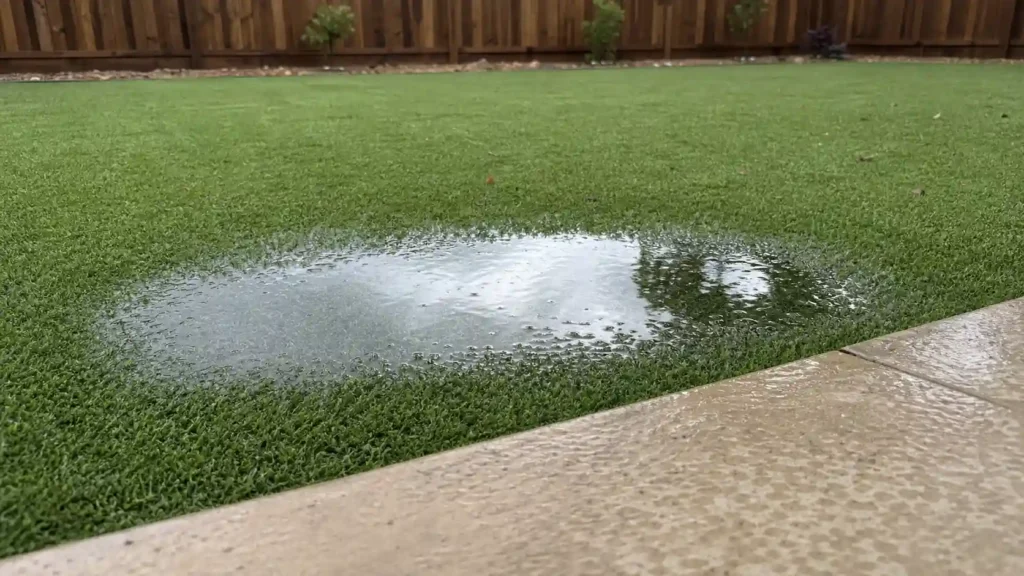
Water sitting on your lawn after rain is not normal, even with artificial turf. If you want to know how to fix drainage problems under artificial turf, the short answer is this: find the exact point where water stops moving, then fix that point. The cause is usually a blocked drainage hole, compacted soil, a weak sub-base, a low spot, poor slope, or pet urine buildup.
Don’t guess and add a fix at random. A French drain will not help if the real problem is compacted soil three inches down. Find the failure point first, then apply the right repair.
How to Tell If Your Artificial Turf Has a Drainage Problem
Some drainage issues are easy to spot. Others only appear after a heavy rain. Look for these signs:
- Standing water that sits for more than 20 to 30 minutes after rain
- Slow drainage, where water moves but takes too long to disappear
- Puddles that show up in the same spot every time it rains
- Water collecting near a patio, wall, or other hard surface
- Soft or spongy areas when you walk across the lawn
- Water pooling near a pet’s favorite bathroom spot
The location matters. A puddle in one low spot points to a different problem than water staying across the entire yard.
If water disappears quickly from most of the turf but remains in one area, start with that area. The problem may be a low spot, poor grade, or a localized base issue.
How Artificial Turf Is Supposed to Drain Water
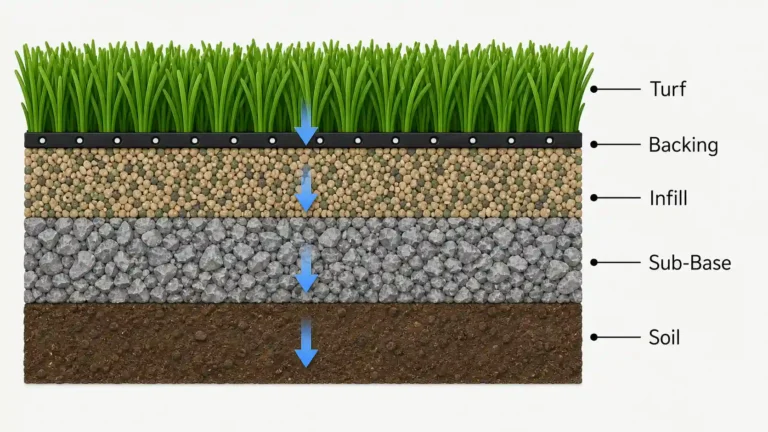
Before you fix anything, it helps to know the normal path water should take. Water moves through five layers, in this order:
Turf surface → perforated backing → infill → sub-base → native soil (or a drainage outlet)
Each layer has one job. The backing has drainage holes punched through it. The infill sits between the grass fibers and lets water pass instead of blocking it. The sub-base is a compacted layer of aggregate that holds the turf’s shape and lets water keep moving down. Below that is your native soil, which either absorbs water or lets it run off.
A drainage problem means one of these layers stopped doing its job. Some of these issues start at the original build. If your turf was installed with the wrong slope or a shallow sub-base, drainage problems can show up months or years later. Reviewing a complete artificial grass installation process is a good way to check if your original build skipped a step that matters now.
For a quick explanation of the normal water path, see our guide on how artificial turf drains water. It helps explain the system before you troubleshoot a failure.
How to Fix Common Artificial Turf Drainage Problems
Here is where we get specific. Each cause below needs a different fix. Don’t apply all of them at once. Match the fix to the actual problem you found.
Fix Standing Water and Recurring Puddles
First, figure out if the water sits in one exact spot or spreads across the whole lawn. One spot usually means a low area or a dip in the base. A spread-out problem usually points to a bigger issue below the surface.
Check where the water is coming from. Is it just rain landing on the turf, or is water running in from a neighboring yard, patio, or downspout? You can’t fix turf drainage if the real source is water flowing in from somewhere else.
Next, check if the turf itself drains but the ground underneath does not. Pour a bucket of water on the spot. If it disappears fast through the turf but reappears minutes later, the turf is fine and the ground below is the problem. In that case, don’t disturb the surface. The fix has to happen at the sub-base or soil level, which we cover next.
Typical cost: Fixing one small low spot by lifting the turf and adding aggregate usually runs $150 to $400 for a standard residential yard, depending on size and access.
Clear Blocked Drainage Holes and Backing
Turf backing has small holes designed to let water pass through. Over time, dirt, dust, and fine sediment settle into these holes and slow the flow.
To check this, peel back a small section of turf and look at the backing. If the holes look packed with debris, that’s your answer. Clear the visible debris by hand or with a soft brush. Avoid a high-pressure washer directly on the backing. Too much pressure can push debris deeper into the holes instead of clearing them, and it can loosen the seams.
If clearing the surface debris does not restore normal water flow, the blockage is likely deeper in the infill layer, not just the backing holes.
Typical cost: A professional deep clean and hole clearing service runs $200 to $450 for an average backyard.
Correct Compacted Soil Under Artificial Turf
This is one of the most overlooked causes, and it’s a big one. There’s a difference between turf that drains into the base and water that actually leaves the soil underneath. If your native soil is dense clay or has been compacted by years of foot traffic, water can pass through the turf and the base just fine, then get stuck right below.
You’ll notice this as a soft, waterlogged feel that lasts for hours or days after rain, even though the surface looks dry. Sticking a screwdriver into the ground near the wet area is a quick test. If it’s hard to push in even a few inches, the soil is compacted.
The fix means lifting the turf in that section, breaking up the compacted soil, and improving drainage before putting the base back. This is exactly why ground prep matters before turf ever goes down. If you’re rebuilding a section, our guide on how to prepare the ground for artificial grass walks through the grading and soil steps that prevent this from happening again. In some cases, this problem traces back to turf that was installed over existing grass without properly assessing the soil first.
Typical cost: Correcting compacted soil in a localized area runs $500 to $1,200, depending on depth and square footage.
Repair an Inadequate or Compacted Sub-Base
The sub-base is the aggregate layer that holds your turf’s shape and moves water downward. If it was installed too thin, made from the wrong material, or was never compacted properly, it will settle over time and trap water instead of passing it through.
Signs of this include a sunken feel underfoot, uneven areas that weren’t there at first, and water sitting right at the surface where the base has settled. Fixing it means pulling back the turf in that section, removing the weak base material, and rebuilding it with the right depth of aggregate, compacted properly this time. Our article on whether you need a sub-base for artificial grass explains what a correctly built base should look like, so you know what you’re rebuilding toward.
Typical cost: A localized sub-base rebuild runs $8 to $14 per square foot. A full-yard rebuild for a larger project can run $3,000 or more.
Fix Poor Slope and Low Areas
A lawn can look flat and still hold water. Even a small dip, invisible to the eye, is enough to collect a puddle every time it rains. Turf needs a slight grade, generally a 1 to 2 percent slope, so gravity pulls water away instead of letting it sit.
Check your yard after a rain. Note exactly where water pools and trace it back to the high point it’s flowing from. If water from a patio, driveway, or neighboring yard is draining onto your turf, the fix might not even be on your lawn. It might be redirecting that runoff before it reaches the turf.
Fixing a poor slope means lifting the section, regrading the sub-base to create a proper fall, and giving water a clear path to an exit point instead of a dead end.
Typical cost: Regrading a problem section runs $400 to $900, depending on the size of the area.
Improve Pet Urine Drainage
Pet urine drainage problems happen differently than rainwater problems. Urine and organic waste bind to infill granules and the underside of the backing. Over months, this buildup narrows the space water needs to pass through, even if the base underneath is perfectly fine.
If your pet has one favorite bathroom spot and that’s where the puddling happens, this is very likely the cause. Flushing the area regularly with water helps, but it’s not a permanent fix on its own. The infill in that zone may need to be replaced rather than just rinsed. If the yard is used heavily by pets, switching to a fully permeable backing in that section solves the problem at its source instead of managing it over and over.
Typical cost: Spot infill replacement for pet areas runs $300 to $600 for a moderate-sized zone.
What If Water Still Doesn't Drain After These Fixes?
If water still remains after the visible blockage is addressed, stop treating it as a simple surface problem.
At this point, the failure may be structural.
Surface-level drainage problem
Potential causes include:
- Blocked drainage holes
- Compacted infill
- Debris
- Sediment
- Organic buildup
These problems may be corrected without rebuilding the entire turf system.
Sub-base or subgrade drainage problem
Potential causes include:
- Compacted soil
- Inadequate base
- Settlement
- Low areas
- Poor underlying drainage
These problems often require access beneath the finished turf.
This distinction prevents an expensive mistake. Replacing permeable turf will not solve a saturated subgrade.
Likewise, rebuilding the entire base is unnecessary if a small blockage is preventing water from passing through the backing.
When Do You Need an Artificial Grass Drainage Solution?
Not every yard needs added drainage infrastructure. Most artificial grass drainage solutions work by improving what’s already there, correcting the grade, rebuilding a weak base, or clearing a blocked path. That solves the majority of cases on its own.
A French drain, drainage pipe, or catch basin is only needed when the site itself can’t shed water on its own, such as a low-lying yard, heavy clay soil across the whole property, or water constantly running in from a neighboring property. These are site-specific solutions, not something you should add just because it sounds like a strong fix. Adding drainage pipe to a yard that just needs a compacted, correctly graded base is a waste of money.
Can Artificial Turf Drainage Problems Be Fixed Without Replacing the Turf?
Yes, in most cases. Here’s how to think about it:
- Surface blockage: Usually repairable without lifting the turf at all.
- Localized base or soil issue: The turf needs to be lifted in that one section, repaired, and relaid. The rest of the lawn stays untouched.
- Widespread base or subgrade failure: This is the only case where a larger section, or the full lawn, may need to come up for a proper rebuild.
Full turf replacement is rarely the answer to a drainage problem. The turf itself is usually fine. It’s what’s underneath that failed.
How to Prevent the Same Drainage Problem After Repair
Once you’ve fixed the issue, keep it fixed with these basics:
- Confirm the sub-base has a consistent 1 to 2 percent slope away from structures
- Use a sub-base built from the right aggregate, compacted correctly
- Keep the drainage path clear from the surface down to the soil
- Choose a permeable backing suited to your yard’s actual use, especially with pets
- Address soil conditions before turf goes back down, not after
Skipping any one of these is how the same puddle shows up again next season.
When to Have a Professional Inspect the Drainage Problem
Some drainage issues are simple enough to handle yourself. Others aren’t. Call a professional when:
- Water is still there after normal rainfall, even after you’ve cleared debris
- The same spot pools every single time, no matter what you try
- The turf feels soft over a large or growing area
- You suspect the problem is under the turf, not on top of it
- The base appears to have settled or shifted
- Surface-level fixes haven’t changed anything after one or two rain events
A licensed installer can dig down, see exactly which layer failed, and rebuild it correctly instead of guessing. If you’re in the area and need hands-on help, SD Home Turf handles both new builds and drainage repairs for artificial turf installation in San Diego County, and we’ll tell you honestly whether your yard needs a small repair or a full base rebuild before any work starts. Reach out for a straightforward assessment and a clear price, not a guess.
The Bottom Line
Good artificial turf drainage depends on the entire system, not just the turf.
When water pools, first identify where the flow stops. Check the backing and drainage holes before moving deeper into the system. If water passes through the turf but remains below it, inspect the infill, sub-base, slope, and soil.
The right artificial grass drainage solutions depend on the cause. Sometimes the fix is small. Sometimes a section of turf must be lifted and rebuilt. Only serious site conditions call for larger systems such as French drains, drainage pipes, or catch basins.
That diagnostic approach helps avoid unnecessary replacement and makes the repair more likely to solve the real problem.
Frequently Asked Questions
Why is water pooling on my artificial turf?
Water usually pools because of a low spot, a blocked drainage hole, or soil underneath that isn’t letting water leave fast enough. Check whether the puddle repeats in the exact same spot every time it rains, which points to grade or base issues rather than a one-time event.
Why does my artificial grass drain slowly after rain?
Slow drainage often means the infill or backing holes are partly blocked, not fully clogged. It’s an early warning sign that’s easier to fix now than after it turns into standing water.
Can compacted soil cause artificial turf drainage problems?
Yes. Compacted soil stops water from leaving the ground, even if the turf and base above it are draining correctly. This is one of the most missed causes because the surface can look dry while the ground underneath stays soaked.
Can a bad sub-base cause artificial turf to hold water?
Yes. A sub-base that’s too thin, made from the wrong material, or poorly compacted will settle over time and create low points that trap water instead of moving it through.
Do clogged drainage holes cause standing water?
They can, especially in high-traffic or dusty areas where debris builds up faster. Clearing the holes restores flow in many cases, but if water still doesn’t move after clearing, the block is likely deeper in the infill or base.
Can poor grading cause artificial turf drainage problems?
Yes, and it’s one of the most common causes. A yard needs a slight, consistent slope to move water away. Even a small low point that’s hard to see with the naked eye can hold a full puddle after rain.
Can pet urine cause artificial turf drainage problems?
Yes. Urine and waste bind to infill and the underside of the backing over time, narrowing the space water needs to pass through. This shows up as pooling in one specific spot where a pet regularly goes.
Do I have to remove artificial turf to fix drainage?
Not usually. Most fixes only require lifting the turf in the affected section, not removing the whole lawn. Full removal is reserved for widespread base or soil failure across most of the yard.